Showing posts with label Boeing. Show all posts

February 3, 2014

SINGAPORE: A350 and 787 set to face off


The rival latest-generation widebodies from Airbus and Boeing will go head to head at an air show for the first time at the Singapore air show, which kicks off on 11 February.
Southeast Asia is a key battleground for the contest between the A350 and the 787, with the Asia-Pacific region accounting for one-third of all sales of the two twinjets.

It will be the first full appearance at an air show by the A350-900. The aircraft’s last public appearance was a fly-past towards the end of the 2013 Paris air show, a week after making its maiden flight.
While the A350 – bearing registration MSN 003 – will take part in the flying display, it is not certain whether it will be joined by the 787. Boeing will only confirm that the Qatar Airways-liveried Dreamliner will be on the static display, although the US manufacturer did memorably return to air show flying at Farnborough  2012 after a 30-year hiatus with a Qatar 787.

All eyes will be on whether the airframers can secure further deals for their new types. Singapore Airlines has already split its loyalties. The city-state’s flag carrier has firm orders for 70 A350-900s, while it is also launch customer for the 787-10, with 30 on order.

Indonesia’s Garuda and Philippine Airlines are looking to the A350 or 787 as a possible replacement for A330s, while Malaysia Airlines is evaluating the A350 and 787 to replace 777-200ERs, although it may plump for the high-gross-weight version of the A330, according to Flightglobal’s Ascend advisory service.
While the Singapore show – held at the Changi Exhibition Centre near the island’s international airport – is unlikely to see the sort of eye-watering mega orders witnessed at Dubai in November, the continued buoyancy of the Southeast Asian market is likely to see plenty of activity for the main airframers.

Singapore Airlines may choose the show to announce an order for the Boeing 777X, joining the three big Gulf airlines which ordered the long-range twinjet at Dubai, as well as its Asian rival Cathay Pacific. Even if Singapore Airlines fails to place a commitment, other heavy hitters in the region may be keen to lock-in delivery slots.

We might see confirmation of an order for 20 A380s from new kid on the leasing block Doric – Airbus expects the contract to be signed in the first quarter. And Indonesia’s Lion Air could use the show to announce its engine choice for the hundreds of A320s it has on order.

On the defence side, Singapore has requested a major upgrade for its 60 F-16s. If the government decides to compete it, it could prompt a battle between original equipment manufacturer Lockheed Martin and BAE Systems to be lead contractor – and between Northrop Grumman and Raytheon to supply the latest-generation radar.

The island state is also a security co-operation participant in the F-35 programme, and its defence minister recently witnessed a flight demonstration of the short take-off and vertical landing B variant in the USA. Meanwhile, Singapore’s airlift requirements should also be interesting, with reports that the government is interested in the Airbus A330 MRTT and Boeing’s C-17.

Historic head-to-heads
There have been some memorable face-offs between competitor aircraft at air shows. Here are just some of them:
Paris 1969: A new era dawns as Europe’s rising supersonic star Concorde squares up with the USA’s just-flown jumbo, the Boeing 747
Paris 1971: A return for Concorde, this time a chance to compare it with its Russian counterpart, the Tupolev Tu-144
Paris 1973: Airbus emerges on the scene with the A300B. Not to be outdone, Lockheed’s L1011 TriStar joins it for one day
Farnborough 1986Regional rivalry between the BAe 146 and the Fokker 100
Paris 1995: Widebody war as Airbus showed its A330 and A340, and Boeing its 777-200
Farnborough 2004: Boeing and Northrop Grumman unveil full-scale mock-ups of their competing Joint Unmanned Combat Air System (J-UCAS) demonstrators
Paris 2011: Battle of the big boys, with the Airbus A380 in the flying display and the Boeing 747-8 in the static.

Flight Global 

February 1, 2014

Latest Pictures of Air Canada's FIRST 787 (DreamLiner)


In these latest pictures from Boeing's hangar in Seattle, notice the oversized yellow boxes hanging from each wing of our first Dreamliner. Those heavy boxes are used as placeholders until the actual engines, which weigh more than 10,000lb each, can be installed. This way, the wing will keep it shape. Notice anything else that’s new? The landing gear, which are largely manufactured here in Canada, are also in place. More pictures to come next week. Stay Tuned! 

Photo Credit: Boeing Images

Photo Credit: Boeing Images 

Photo Credit: Boeing Images

Photo Credit: Boeing Images

Photo Credit: Boeing Images

Boeing/AirCanada 

Airlines begin push for discounted end-of-line 777s


Airlines are beginning to push for discounts on current generation Boeing 777s, as the airframer looks to bridge a gap in deliveries until the 777X enters service at the end of the decade.

“I think it is common knowledge that aircraft tend to be sold to large and good customers with substantial discounts,” says Christoph Franz, chief executive of the Lufthansa Group, on a potential 777 discount during a media event in New York on 30 January. “So, the question of if there is additional discount to the existing discount, that is an interesting question. Hopefully, we would be able to achieve this discount.”
The list price of a 777 freighter is $300.5 million, according to Boeing.

Photo Credit: Flight Global


The group’s freight arm Lufthansa Cargo operates two 777 freighters with three more on order. However, it has not selected a replacement for the 13 Boeing MD-11s that will remain in its fleet after the last 777 delivery in 2015.

“There are at least 13 MD-11 freighters waiting for roll over,” says Franz. “For us, this gives a perspective that there will be demand in the future for further freighter aircraft and the 777, as we have already five on our orderbook, is a nice aircraft and hopefully we would be one of the customers.”

This is where further discounts could come in.

The Chicago-based airframer faces a steep drop in 777 deliveries after 2016. Deliveries will fall to just six in 2018 from 56 in 2016, Flightglobal’s Ascend Online database shows. They pick up again with the entry-into-service of the 777-9X in 2020.
Boeing acknowledges a need to fill this gap.

“We anticipate being able to build that bridge over the next number of years as we approach 2020,” said Jim McNerney, chairman and chief executive of Boeing, during an earnings call on 29 January. “We are working with [customers] on combined orders for the current 777 as well as the new one. And we anticipate at least the same kind of result that we had with the [7]37.”
Boeing has discounted end-of-line next generation 737s, which helped it land an order from Ryanair for 175 737-800s in March 2013. Deliveries will continue through 2018.

The first 737 Max delivery is scheduled for the second quarter of 2017.
Boeing’s cost control initiatives are critical to any 777 discounts. These include the partnership for success programme where the airframer is forging long-term partnerships with certain suppliers in order to reduce costs in the near term, and its new contract with the International Association of Machinists and Aerospace Workers (IAM) for work on the widebody.

McNerney implied in his recent comments that these initiatives will likely help Boeing maintain its profit margins on the current generation 777 during the bridge.
“Now the partnering for success will be hitting it's mid-stride right around the time that the [777] bridge is being implemented and that’s not by accident,” he said.

In addition to discounts, Boeing could reduce the production rate of the 777 from 8.3 per month – about 100 aircraft per year – to help counter the gap in deliveries.
Lufthansa Cargo became the first operator of the type in the group, when it took delivery of its first 777 freighter in November 2013.

Entry-into-service was uneventful, says Franz. “The best news of it – I didn’t get any complaints,” he says.
Swiss will begin taking delivery of six 777-300ERs begin in 2016 and Lufthansa has an order for 34 777-9X aircraft with deliveries beginning after 2020.

Flight Global

January 29, 2014

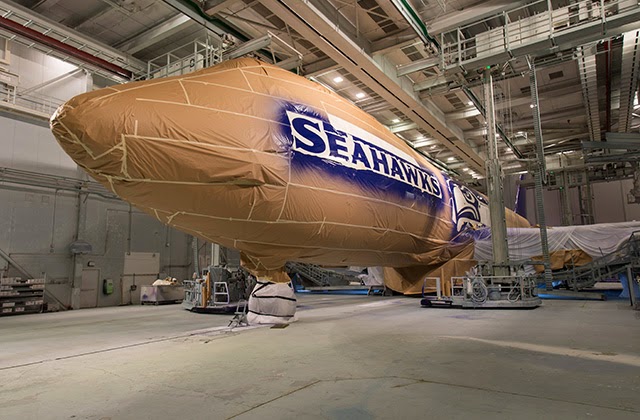
Boeing's New Test Plane: B747-800 with the Seattle Seahawk Livery


EVERETT, Wash., Jan. 29, 2014 /PRNewswire/ -- Boeing (NYSE: BA) today revealed a 747-8 Freighter painted in the livery of the NFL's Seattle Seahawks. The livery commemorates the team's National Football Conference Championship and upcoming appearance in Super Bowl XLVIII.

Boeing is a sponsor of the Seattle Seahawks and has partnered with the team for more than a decade on programs in the Puget Sound area.

"The Seahawks have been an inspiration to our entire community throughout this incredible season," said Boeing Commercial Airplanes President and CEO Ray Conner. "We're honored that we could join together two Northwest icons, the Seahawks and the 747, for this special salute from the entire Boeing team."
This 747-8 is owned by Boeing and currently being used for flight testing. The special livery features the distinctive Seahawks logo and a "12" on the tail to salute the team's fans. The airplane will make its first flight in its new livery on Thurs., Jan. 30.


"The 747 team is proud that one of our airplanes could be used as a tribute to the Seahawks' success this season and a rallying cry for the team as they prepare for the Super Bowl," said Eric Lindblad, vice president and general manager, 747 program, Boeing Commercial Airplanes. "The partnerships we have with the Seahawks and others are making a positive difference in the communities where Boeing employees live and work. We join with all Seahawks fans in wishing the team success on Sunday."


Photo Credit: Boeing Images

Photo Credit: Boeing Images

Photo Credit: Boeing Images 

Photo Credit: Boeing Images

Photo Credit: Boeing Images

Photo Credit: Boeing Images

Photo Credit: Boeing Images

Photo Credit: Boeing Images 

Photo Credit: Boeing Images 

Photo Credit: Boeing Images

Photo Credit: Boeing Images 

Photo Credit: Boeing Images 

The Bird is ready to FLY...

Boeing Reports Record 2013 Revenue, EPS and Backlog and Provides 2014 Guidance


These are key tables in this morning's Financial Statement released by Boeing.


The Boeing Company and Subsidiaries
Consolidated Statements of Operations
(Unaudited)


Twelve months
ended December 31

Three months
ended December 31
(Dollars in millions, except per share data)
2013

2012

2013

2012

Sales of products
$76,792

$71,234

$21,482

$19,793
Sales of services
9,831

10,464

2,303

2,509
Total revenues
86,623

81,698

23,785

22,302


Cost of products
(65,640)

(60,309)

(18,610)

(17,206)
Cost of services
(7,553)

(8,247)

(1,758)

(1,816)
Boeing Capital interest expense
(75)

(109)

(20)

(24)
Total costs and expenses
(73,268)

(68,665)

(20,388)

(19,046)

13,355

13,033

3,397

3,256
Income from operating investments, net
214

268

67

57
General and administrative expense
(3,956)

(3,717)

(1,100)

(943)
Research and development expense, net
(3,071)

(3,298)

(848)

(753)
Gain/(loss) on dispositions, net
20

4

(1)

7
Earnings from operations
6,562

6,290

1,515

1,624
Other income, net
56

62

15

23
Interest and debt expense
(386)

(442)

(96)

(112)
Earnings before income taxes
6,232

5,910

1,434

1,535
Income tax expense
(1,646)

(2,007)

(201)

(557)
Net earnings from continuing operations
4,586

3,903

1,233

978
Net loss on disposal of discontinued operations, net of taxes of $0 and $2
(1)

(3)


Net earnings
$4,585

$3,900

$1,233

$978
Basic earnings per share from continuing operations
$6.03

$5.15

$1.63

$1.29
Net loss on disposal of discontinued operations, net of taxes


Basic earnings per share
$6.03

$5.15

$1.63

$1.29
Diluted earnings per share from continuing operations
$5.96

$5.11

$1.61

$1.28
Net loss on disposal of discontinued operations, net of taxes


Diluted earnings per share
$5.96

$5.11

$1.61

$1.28
Cash dividends paid per share
$1.94

$1.76

$0.485

$0.44
Weighted average diluted shares (millions)
769.5

763.8

768.4

768.3


Comment: From their statement, Boeing has a greater margin in their services group as opposed to their products group. Comparing the margin from 2012 to 2013, Boeing performed better in 2012 than in 2013. For the most part, Boeing has done very well. 


The Boeing Company and Subsidiaries
Summary of Business Segment Data
(Unaudited)


Twelve months ended
December 31

Three months ended
December 31
(Dollars in millions)
2013

2012

2013

2012
Revenues:


  Commercial Airplanes
$52,981

$49,127

$14,680

$14,161
  Defense, Space & Security:


  Boeing Military Aircraft
15,936

16,019

4,395

4,037
  Network & Space Systems
8,512

7,911

2,272

2,024
  Global Services & Support
8,749

8,677

2,188

2,282
  Total Defense, Space & Security
33,197

32,607

8,855

8,343
  Boeing Capital
408

468

105

129
  Other segment
102

106

22

27
  Unallocated items and eliminations
(65)

(610)

123

(358)
Total revenues
$86,623

$81,698

$23,785

$22,302
Earnings from operations:


  Commercial Airplanes
$5,795

$4,711

$1,506

$1,266
  Defense, Space & Security:


  Boeing Military Aircraft
1,465

1,489

441

313
  Network & Space Systems
719

562

233

138
  Global Services & Support
1,051

1,017

280

300
  Total Defense, Space & Security
3,235

3,068

954

751
  Boeing Capital
107

88

9

(12)
  Other segment
(156)

(186)

(99)

31
  Unallocated items and eliminations
(2,419)

(1,391)

(855)

(412)
Earnings from operations
6,562

6,290

1,515

1,624
Other income, net
56

62

15

23
Interest and debt expense
(386)

(442)

(96)

(112)
Earnings before income taxes
6,232

5,910

1,434

1,535
Income tax expense
(1,646)

(2,007)

(201)

(557)
Net earnings from continuing operations
4,586

3,903

1,233

978
Net loss on disposal of discontinued operations, net of taxes of $0 and $2
(1)

(3)


Net earnings
$4,585

$3,900

$1,233

$978


Research and development expense, net:


  Commercial Airplanes
$1,807

$2,049

$510

$411
  Defense, Space & Security
1,215

1,189

323

321
  Other
49

60

15

21
Total research and development expense, net
$3,071

$3,298

$848

$753


Unallocated items and eliminations:


  Share-based plans
($95)

($81)

($21)

($17)
  Deferred compensation
(238)

(75)

(73)

(26)
  Capitalized interest
(69)

(70)

(17)

(17)
  Eliminations and other
(703)

(266)

(421)

(140)
     Sub-total (included in core operating earnings)
(1,105)

(492)

(532)

(200)
  Pension
(1,374)

(787)

(329)

(179)
  Postretirement
60

(112)

6

(33)
Total unallocated items and eliminations
($2,419)

($1,391)

($855)

($412)


Comment: Boeing had a 7.84%  or $3.8 billion increase in its Commercial airplane division, however, its defense military aircraft under the  Defense, Space & Security division reduced by -0.52% or -$83 million. This isn't so much of a significant loss. The Operating Margin is higher as compared to last year.


The Boeing Company and Subsidiaries
Operating and Financial Data
(Unaudited)

Deliveries

Twelve months ended
December 31

Three months ended
December 31
Commercial Airplanes

2013


2012


2013

2012

737

440


415


110

105

747

24


31


8

10

767

21


26


4

6

777

98


83


25

21

787

65
(1)

46
(3)

25

23
(3)
Total

648


601


172

165


Note: Deliveries under operating lease are identified by parentheses.


Summary: Boeing's decision to ramp up delivery as well decrease backlog so that the company can actually earn that revenue resulted to their increased performance. About a week ago, Boeing announced its increased production and manufacturing rate from 7 to 10 I believe, twice the production rate from last year, this favors Boeing in the long run, and as a result, better performance. I sincerely hope that better performance translates into better and quality products. 

To see more tables, visit Boeing Financials


January 28, 2014

Why I think the A350XWB is a better fit compared to the B787 (The DREAMLINER)


Photo Credit: Boeing Images
As an aviation enthusiast, I want all companies to succeed; however, Boeing’s commercial program has been a huge disappointment lately. The B787 is a great aircraft, the first of its kind in commercial production, it set the precedence for the A350 to evolve, as well as future aviation, but unfortunately, the B787 program fell short and hasn't been very successful.

Like the A380 that flopped and did not break-even, the 787 faces the same fate. The program had a bright future because of its futuristic –ish design and components: 50% composite – less weight and more cost savings – and despite its positive outlook, it failed in delivery. I recalled its successful launch, it was highly publicized, but no sooner than the first sets of aircrafts entered into service, the problems began. It is no news about numerous problems that plagued the program, what had Boeing done wrong, AGAIN?

Airbus having realized that bigger is ALWAYS better, they went back to the drawing board and emerged well prepared with the A350XWB. I strongly believe that the Airbus Company built a better and more efficient design based on Boeing’s failure of the 787 program. Although it’s too early to praise the A350XWB which is scheduled for commercial service the first quarter of 2014, it is highly speculative and anticipated to perform well than its rival.

To me, I’m more concerned about which is better, on the surface, I will peak into these two aircraft and what they have to offer


The 787-800 seats 210 to 250 passengers (average of 230 passengers), and has a range of 7,650 to 8,200 nautical miles (14,200 to 15,200 kilometers) an average of 7,925 miles (14,700 kilometers) and a price tag of  $211 million (Source)

The A350-800 designed to carry 276 passengers in a twin aisle configuration (46 passengers more on average) flying up to 8,250 nautical miles (15,300 kilometers). The price tag is $261 million ($50 million) more than its competitor. 

To me, despite the higher expense, the Airbus is a more cost-effective aircraft and here is why
For the purpose of this exercise, I am assuming a 100% LF and also maximum range, given this scenario,


Boeing’s Available Seat Mile (ASM) is the following
At Min, ASM = 210 passengers x 7,650 nautical miles = 1,606,500
At Max, ASM = 250 passengers x 8,200 nautical miles = 2,050,000
At Avg, ASM = 230 passengers x 7,925 nautical miles = 1,822,750

For the purpose of calculation, I reversed the table to favor Boeing’s B787 because in realism, the more passengers on board (compensating for gross weight), the less fuel carried onboard resulting to less mileage flown.


Airbus ASM = 276 passengers x 8,250 nautical miles = 2,277,000

ASM or Available Seat Mile is an airline measure of carrying capacity of an airplane on a given trip. This measure is utilized by airlines to determine Revenue and Cost because not all seats (ticket) on the aircraft cost the same, therefore, this measure is very important to airlines. To calculate what ASM is, you simply multiply the aircraft's maximum available seats by the destination range or the number of miles flown. 

ASM = Available Seats x Distance flown,

  •  where available seats is total number of seats on the plane - reserved non-revenue seats. Non-revenue could be employees embarking on company business, security escorts like Federal Marshals, etc. 


For instance, A NY to Washington DC flight is operated with a B737-800 and has a seating capacity of 180 passengers flying a distance of 220 nautical miles. However, because it's headed into Washington, DC there are two Marshals on the plane with a mechanic. The ASM is 

ASM =[180 - 3]  x 220  = 38,940 available seat miles. 

I thought I explain this detail before continuing any further. Also, for the purpose of a fair comparison, I assumed the maximum seating capacity as the available seat and maximum range as the number of miles flown. 


Photo Credit: Airbus Images
The Airbus ASM is 11% higher than Boeing’s Maximum scenario; however, this result isn't definitive because it just tells us that Airbus has 11% more operating capacity than Boeing. To the average person, this technical jargon doesn't translate any meaningful information; therefore using Boeing’s Max scenario, it will cost an airline about 32.80 miles/seat (8,200 / 250) in comparison to Airbus which is 29.89 miles/seat (8,250 / 276). Yet, using the industry standard of seat/mile, Boeing s/m is 0.0304 and Airbus is 0.0334.

As you can see, Airbus has more seats/mile which translates into more revenue/mile (if filled). That’s a 9.7% advantage over Boeing. Imagine a 9% ticket reduction in the base fare, though not significant, but that is a good savings. This is how the numbers add up.

Although Airbus does come out on top regardless, it wouldn't make more sense if we don’t evaluate the cost of aircraft into these calculations. The B787 cost $211 million and the A350 cost $261 million, both -800 models, taking a closer look at the Purchase Price – ASM Factor, assuming everything is equal (subsidies, discounts, and what not),  what does it cost to operate a single seat per the cost of the aircraft?

The Initial Cost Price for the 787 is $211 million and the Max ASM is 2,050,000 and this equals to $102.93/ASM compared to Airbus which is $114.62. Using the Max scenario and giving a fair comparison to Airbus, adjusting for the average scenario, the result is $115.17, 55 cents more expensive.

What this means is for instance, assuming the Cost-Available Seat Mile is 8 cents, the aircraft has to fly for extra 7 miles to break-even on the cost and 7 miles when multiplied by the per mile rate, can be several hundred if not thousands of $$$.

In a more realistic scenario, I will give it hands down to the A350XWB, the aircraft though expensive for its class type, happens to be more cost efficient than the 787. Please keep in mind, other factors such as Direct Operating Costs, as well as others wasn't considered. This analysis just expresses the numbers on its face. 

January 25, 2014

Boeing Rolls Out First 787 Dreamliner at Increased Production Rate


  • Program achieves 10 per month rate, highest ever production for a twin-aisle airplane

EVERETT, Wash., Jan. 24, 2014 /PRNewswire/ -- Boeing (NYSE: BA) has rolled out the first Boeing 787 Dreamliner built at the rate of 10 airplanes per month. The airplane, a 787-8 and the 155th Dreamliner built, will be delivered to International Lease Finance Corp. for operation by Aeromexico.

The new 10 per month rate is the highest ever for a twin-aisle airplane. The 787 program has now increased its production rate three times in just over a year, including to five airplanes per month in November 2012 and seven per month in May 2013.

EVERETT, Wash., Jan. 24, 2014 – Boeing [NYSE: BA] has rolled out the first Boeing 787 Dreamliner built at the rate of 10 airplanes per month.
Pictured here is the airplane, a 787-8, which will be delivered to International Lease Finance Corp. for operation by Aeromexico.
"This rate increase reflects the continued strong demand for the 787," said Larry Loftis, vice president and general manager, 787 program, Boeing Commercial Airplanes. "A disciplined approach that combined employee teamwork with technology was key to achieving the higher rate."
Boeing assembles and delivers 787s in two locations: Everett, Wash., and North Charleston, S.C.

"The entire 787 team is now focused on capturing efficiencies at this historic level of production, as well as meeting our commitment to increase the production rate to 12 per month in 2016 and to 14 per month by the end of the decade," Loftis said.

To date, 115 787s have been delivered to 16 customers. The program has 1,030 total orders from 60 customers worldwide.

This airplane will be the fourth 787 operated by Aeromexico and will be used on the airline's Mexico City - London Heathrow route.

Boeing Media

At the rate of 10 airplanes a month without any hitches or glitches in the production and manufacturing chain process, or yet, the quality assurance aspect which includes the current mechanical and electrical setbacks facing the 787 program, assuming everything is constant, which include

a. no more orders from customers
b. no cancelled or revoked purchase contracts
c. no addition, revision to existing contracts or any other event

Given this scenario,  it would take Boeing an estimated 91.5 months which is equivalent to 7 years, 8 months and 15 days to fully deliver. The 787 design has endeared a lot of negative setback, and while the positive outweighs the negative, I hope that Boeing lives up to expectation, and not in the bid to push out orders, quality is compromised.