Showing posts with label A350. Show all posts

February 3, 2014

SINGAPORE: A350 and 787 set to face off


The rival latest-generation widebodies from Airbus and Boeing will go head to head at an air show for the first time at the Singapore air show, which kicks off on 11 February.
Southeast Asia is a key battleground for the contest between the A350 and the 787, with the Asia-Pacific region accounting for one-third of all sales of the two twinjets.

It will be the first full appearance at an air show by the A350-900. The aircraft’s last public appearance was a fly-past towards the end of the 2013 Paris air show, a week after making its maiden flight.
While the A350 – bearing registration MSN 003 – will take part in the flying display, it is not certain whether it will be joined by the 787. Boeing will only confirm that the Qatar Airways-liveried Dreamliner will be on the static display, although the US manufacturer did memorably return to air show flying at Farnborough  2012 after a 30-year hiatus with a Qatar 787.

All eyes will be on whether the airframers can secure further deals for their new types. Singapore Airlines has already split its loyalties. The city-state’s flag carrier has firm orders for 70 A350-900s, while it is also launch customer for the 787-10, with 30 on order.

Indonesia’s Garuda and Philippine Airlines are looking to the A350 or 787 as a possible replacement for A330s, while Malaysia Airlines is evaluating the A350 and 787 to replace 777-200ERs, although it may plump for the high-gross-weight version of the A330, according to Flightglobal’s Ascend advisory service.
While the Singapore show – held at the Changi Exhibition Centre near the island’s international airport – is unlikely to see the sort of eye-watering mega orders witnessed at Dubai in November, the continued buoyancy of the Southeast Asian market is likely to see plenty of activity for the main airframers.

Singapore Airlines may choose the show to announce an order for the Boeing 777X, joining the three big Gulf airlines which ordered the long-range twinjet at Dubai, as well as its Asian rival Cathay Pacific. Even if Singapore Airlines fails to place a commitment, other heavy hitters in the region may be keen to lock-in delivery slots.

We might see confirmation of an order for 20 A380s from new kid on the leasing block Doric – Airbus expects the contract to be signed in the first quarter. And Indonesia’s Lion Air could use the show to announce its engine choice for the hundreds of A320s it has on order.

On the defence side, Singapore has requested a major upgrade for its 60 F-16s. If the government decides to compete it, it could prompt a battle between original equipment manufacturer Lockheed Martin and BAE Systems to be lead contractor – and between Northrop Grumman and Raytheon to supply the latest-generation radar.

The island state is also a security co-operation participant in the F-35 programme, and its defence minister recently witnessed a flight demonstration of the short take-off and vertical landing B variant in the USA. Meanwhile, Singapore’s airlift requirements should also be interesting, with reports that the government is interested in the Airbus A330 MRTT and Boeing’s C-17.

Historic head-to-heads
There have been some memorable face-offs between competitor aircraft at air shows. Here are just some of them:
Paris 1969: A new era dawns as Europe’s rising supersonic star Concorde squares up with the USA’s just-flown jumbo, the Boeing 747
Paris 1971: A return for Concorde, this time a chance to compare it with its Russian counterpart, the Tupolev Tu-144
Paris 1973: Airbus emerges on the scene with the A300B. Not to be outdone, Lockheed’s L1011 TriStar joins it for one day
Farnborough 1986Regional rivalry between the BAe 146 and the Fokker 100
Paris 1995: Widebody war as Airbus showed its A330 and A340, and Boeing its 777-200
Farnborough 2004: Boeing and Northrop Grumman unveil full-scale mock-ups of their competing Joint Unmanned Combat Air System (J-UCAS) demonstrators
Paris 2011: Battle of the big boys, with the Airbus A380 in the flying display and the Boeing 747-8 in the static.

Flight Global 

April 16, 2012

Airbus Starts Final Assembly of First A350 XWB


Photo Credit: Airbus Images
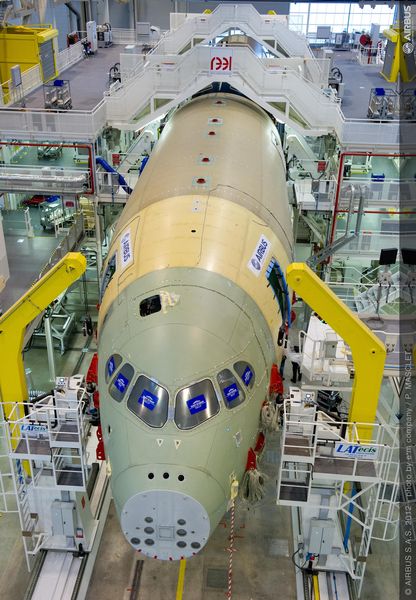
Final assembly of the first A350 XWB is now underway at the brand new final assembly line in Toulouse. This latest step in the A350 XWB’s progress is achieved as Airbus starts joining the 19.7 metre long centre fuselage with the 21 metre long front fuselage.

This first A350 XWB airframe will be used for the static structural tests that all new aircraft undergo as part of their certification process. The assembly of the first flying A350 XWB, MSN1, will start during summer.

The centre fuselage was delivered to Toulouse on Wednesday 4th April 2012 by Beluga from Airbus in St Nazaire, France. The front fuselage was previously delivered from St Nazaire to the A350 XWB final assembly line on the 23rd December 2011. Delivery and installation of the aft fuselage from Hamburg, Germany will take place in the coming weeks, followed by the wings delivered from Airbus’ wing assembly site in Broughton, UK.

Airbus Images
The A350 XWB fuselage is made up of three main sections - front, centre and aft. These will be joined together at the first main assembly station, Station 50. The nose landing-gear is also joined here. Once this stage is completed, the fuselage is transferred to Station 40 where the wings and tail sections are joined.  In parallel to this, cabin installation will be carried out simultaneously to the wing-fuselage join up, as well as the “power on” of the aircraft systems. In this way, functional tests can start earlier than on previous programmes. 

Airbus Images
The A350 XWB is Airbus’ all new family of mid-size widebody airliners. These highly efficient aircraft bring together the latest in aerodynamics, design and advanced technologies to provide up to 25 percent better fuel efficiency and operating costs compared to current aircraft in the same size category. Over 70 percent of the A350 XWB’s weight-efficient airframe is made from advanced materials combining composites (53 percent), titanium and advanced aluminium alloys. The aircraft’s innovative all-new Carbon Fibre Reinforced Plastic (CFRP) fuselage results in lower fuel burn as well as easier maintenance. The A350 XWB benefits from Airbus’ high level of expertise in incorporating composite material into its aircraft.

The A350 XWB Family consists of three passenger versions with true long-range capability of flying up to 8,500nm/15,580km. In a typical three-class configuration, the A350-800 will offer 270 seats while the A350-900 and the A350-1000 will offer 314 and 350 seats respectively.


Airbus Media


March 15, 2012

India needs over 1,040 aircraft worth US$145 billion in next 20 years


Demand for larger Eco-efficient aircraft
 According to Airbus’ latest market forecast, Indian carriers will require 1,043 new passenger (1,020) and freighter (23) aircraft valued at US$145 billion between now and 2030 to satisfy surging annual demand. India’s market for new aircraft makes it the world’s fourth largest in both number of aircraft and value.
Indian annual passenger traffic growth rates of 7.2 per cent are well above the regional Asia Pacific average growth rate of 5.9 per cent and the world average 4.8 per cent.

Of the requirement for 1,020 new passenger aircraft, some 860 will be for growth and 160 to replace the eldest aircraft in the existing fleet of 327. By 2030, this means that India’s passenger fleet will more than triple to some 1,180 aircraft. The new passenger aircraft include 646 single aisles like the A320 and A320neo Family, 308 twin aisles like the A350 XWB and A330, and 66 very large aircraft such as the A380.

Growing urbanization and population concentrations combined with a growing middle class and dynamic economic growth are driving demand and this trend is expected to continue. Despite near term challenges, the Indian economy is forecast to continue expanding, helping India’s growth in domestic air travel to reach even higher growth rates of nearly 10 per cent annually, making it one of the fastest growing aviation markets anywhere in the world.

“By 2030, India’s economy is forecast to be the fourth largest in the world creating exceptional potential for growth in the aviation sector. Through our Indian industrial partnerships we are proud to boast that every A320 today is partly made in India,” said Dr. Kiran Rao, Airbus Executive Vice President, Sales and Marketing, and President of Airbus India. “Our engineering and industrial footprint in India supports over 2,000 highly skilled Indian jobs throughout our supply chain, and this figure is growing.”

Airbus’ partnership with India dates back almost 40 years. Today, half of all A320 forward doors and all flap track beams are produced in India. Established in 2006, the Airbus Engineering Centre India (AECI) in Bangalore employs over 270 highly skilled local engineers working in high end analysis and design on all Airbus products. The center is expected to grow to 450 over the next three years. Airbus recently established a second pilot training center in Noida (this one in cooperation with CAE and Interglobe) to complement the existing facility in Bangalore. Combined, they will have the capacity to train up to 5,000 pilots and maintenance engineers per year. Airbus’ market share of new aircraft orders in India is over 70 per cent.


March 1, 2012

Aer Lingus Expects More A350 Delays


Aer Lingus expects further delays in the delivery of the Airbus A350, CEO Christoph Mueller tells Aviation Week, and plans to begin talks with the airframer about a new delivery schedule for the carrier’s nine A350-900s on firm order.

Airbus late last year delayed entry into service of the aircraft by up to six months, with the first A350-900 now expected in the first half of 2014. The shift was due to the late completion of major components. At the time, A350 program chief Didier Evrard said Airbus wants to limit the amount of traveled work in final assembly, trying to avoid the issues that Boeing has faced in the 787 program. Mueller says he expects delays beyond the ones announced by Airbus. The airline is due to receive its first A350-900 in 2015.

The airline is nonetheless progressing with fleet planning. Mueller says the A321NEO would be the “ideal aircraft” for Aer Lingus’s transatlantic routes, which currently are served by four A330-300s and three -200s. The A321NEO would have enough range for the Dublin-New York and Dublin-Boston routes, but it could not be used for the Chicago service. The airline has not yet ordered new narrow-bodies. It currently has a one A319, 34 A320s and three A321s.

Aer Lingus managed to reach a €49 million ($66 million) operating profit in 2011, a much better result than anticipated at the start of last year and a margin of 4.7%. The profit was only slightly below the 2010 earnings (€52 million). The carrier attributed the success mainly to a 4.8% improvement in average yield per passenger. Revenues increased by 6% to €1.3 billion.

Demand is particularly strong in the business travel market, and the airline finds its long-haul, business-class cabin is becoming “too small.” The airline therefore plans soon to make an announcement about increased long-haul premium capacity.

Mueller says Aer Lingus has increased its market share in Ireland by 8% since 2008 and now has a share of 43.9%. The carrier has focused on more frequencies in core markets and reduced exposure to charter-type low-frequency destinations. That also has helped with improving connectivity at its Dublin base.

The airline plans to continue operating outside the global alliances, saying they are “too expensive.” It would reconsider if the cost of joining and maintaining membership decreased. Mueller still expects Ireland to proceed with Aer Lingus’s privatization this year, although that schedule may shift to early 2013.

He says he has only read in the press about Etihad Airways supposedly being interested in investing in Aer Lingus, but he cautions that another airline shareholder would only make sense if the arrangement did not have any negative consequences for Aer Lingus’s bilateral relationships with other carriers. Mueller says he is not sure that is the case for Air Berlin. Etihad recently bought 29% of the German airline, which is due to join the Oneworld alliance in March.

Aviation Week

February 21, 2012

Airbus to decide on A330 enhancement in second half of 2012


A350 Concept
Airbus intends to decide whether to proceed with enhancements to the A330 during the second half of this year, but is still reticent to provide many details. The airframer is studying the possibility of raising the maximum take-off weight of the A330-300 by 5t, taking it to 240t and potentially prolonging the life of the type as it develops the A350 XWB. However, its strategy for achieving the additional capability remains unclear, beyond indications last month that "sharklet" wing-tips could be adapted to the larger twinjet.

Discontinuation of the A340 potentially offers a mechanism to reduce weight, as there would be no need to maintain structural commonalities between the two types. While the A330 would have been structurally different as a "clean sheet" aircraft, Airbus would need to assess whether there is room to make any economical alterations on its production line.

Proposals for a higher-weight A330 revive a plan to create a longer-range version of the -300, discussed by the airframer more than a decade ago. That plan also aimed for a 240t take-off weight, as well as higher-thrust engines. But the A330-300's take-off weight remained at 233t until last year, when the airframer offered a 2t hike to 235t. Airbus would want to avoid any major change on the undercarriage. While it had previously considered adopting the A340's distinctive centre gear to reduce pavement loading, such a decision would simply add weight - and complexity.

All three major engine manufacturers offer A330-300 power-plants. There is no immediate evidence that Airbus is considering re-engining the A330, a move which would essentially bring the airframer back to the original A350 - a concept which received a tepid response from the market when first promoted as a Boeing 787 rival. Airbus is giving little away, although it has indicated further details could be released during the Farnborough air show.

"As part of Airbus's philosophy, we are continuously looking at the market and studying further improvements to our portfolio," said the airframer. "Any decision on whether to proceed will happen in the second half of 2012."

 Source: Flight Global

February 18, 2012

Virtual reality supports the A350 XWB’s design and development


Airbus Leading in Aerospace Technology and Innovation 

Innovation has always been at the forefront of Airbus’ leadership, and the company is now gaining further benefit from innovative concepts that originate within its EADS parent company.

One example displayed at the Singapore Airshow is the RHEA (Realistic Human Ergonomic Analysis) development tool, which was conceived by EADS Innovation Works – the research and technology organization at EADS.  RHEA results from more than a decade of EADS work in creating virtual 3D environments that enable engineers to interact with computer-generated mock-ups, which are increasingly used in the aerospace sector.

RHEA enables operators to “enter” and interact with a full-scale 3D digital model by wearing special goggles, helmet-mounted displays, or even as an avatar artificial figure with human dimensions.
Following the successful introduction of RHEA at the Eurocopter helicopter business unit of EADS, this software was put into service by Airbus in supporting the A350 XWB’s design and development at French plants in Toulouse and St. Nazaire, as well as Hamburg, Germany.

The deployment of RHEA’s virtual reality world was further expanded at Airbus with its application at St. Nazaire to help train production workers as they move the A350 XWB into production.


The Airbus 350 XWB (Extra Wide-Body) is a STRONG competitor to the Boeing 787  dubbed "The Dreamliner". These airliners are similar because the fuselage and wings from both are made from reinforced carbon composite materials as opposed to sheet metal which results to less weight, thus making it more fuel-efficient and more environment friendly. 

You can read more at Boeing and Airbus Websites