Showing posts with label Airbus. Show all posts

February 3, 2014

SINGAPORE: A350 and 787 set to face off


The rival latest-generation widebodies from Airbus and Boeing will go head to head at an air show for the first time at the Singapore air show, which kicks off on 11 February.
Southeast Asia is a key battleground for the contest between the A350 and the 787, with the Asia-Pacific region accounting for one-third of all sales of the two twinjets.

It will be the first full appearance at an air show by the A350-900. The aircraft’s last public appearance was a fly-past towards the end of the 2013 Paris air show, a week after making its maiden flight.
While the A350 – bearing registration MSN 003 – will take part in the flying display, it is not certain whether it will be joined by the 787. Boeing will only confirm that the Qatar Airways-liveried Dreamliner will be on the static display, although the US manufacturer did memorably return to air show flying at Farnborough  2012 after a 30-year hiatus with a Qatar 787.

All eyes will be on whether the airframers can secure further deals for their new types. Singapore Airlines has already split its loyalties. The city-state’s flag carrier has firm orders for 70 A350-900s, while it is also launch customer for the 787-10, with 30 on order.

Indonesia’s Garuda and Philippine Airlines are looking to the A350 or 787 as a possible replacement for A330s, while Malaysia Airlines is evaluating the A350 and 787 to replace 777-200ERs, although it may plump for the high-gross-weight version of the A330, according to Flightglobal’s Ascend advisory service.
While the Singapore show – held at the Changi Exhibition Centre near the island’s international airport – is unlikely to see the sort of eye-watering mega orders witnessed at Dubai in November, the continued buoyancy of the Southeast Asian market is likely to see plenty of activity for the main airframers.

Singapore Airlines may choose the show to announce an order for the Boeing 777X, joining the three big Gulf airlines which ordered the long-range twinjet at Dubai, as well as its Asian rival Cathay Pacific. Even if Singapore Airlines fails to place a commitment, other heavy hitters in the region may be keen to lock-in delivery slots.

We might see confirmation of an order for 20 A380s from new kid on the leasing block Doric – Airbus expects the contract to be signed in the first quarter. And Indonesia’s Lion Air could use the show to announce its engine choice for the hundreds of A320s it has on order.

On the defence side, Singapore has requested a major upgrade for its 60 F-16s. If the government decides to compete it, it could prompt a battle between original equipment manufacturer Lockheed Martin and BAE Systems to be lead contractor – and between Northrop Grumman and Raytheon to supply the latest-generation radar.

The island state is also a security co-operation participant in the F-35 programme, and its defence minister recently witnessed a flight demonstration of the short take-off and vertical landing B variant in the USA. Meanwhile, Singapore’s airlift requirements should also be interesting, with reports that the government is interested in the Airbus A330 MRTT and Boeing’s C-17.

Historic head-to-heads
There have been some memorable face-offs between competitor aircraft at air shows. Here are just some of them:
Paris 1969: A new era dawns as Europe’s rising supersonic star Concorde squares up with the USA’s just-flown jumbo, the Boeing 747
Paris 1971: A return for Concorde, this time a chance to compare it with its Russian counterpart, the Tupolev Tu-144
Paris 1973: Airbus emerges on the scene with the A300B. Not to be outdone, Lockheed’s L1011 TriStar joins it for one day
Farnborough 1986Regional rivalry between the BAe 146 and the Fokker 100
Paris 1995: Widebody war as Airbus showed its A330 and A340, and Boeing its 777-200
Farnborough 2004: Boeing and Northrop Grumman unveil full-scale mock-ups of their competing Joint Unmanned Combat Air System (J-UCAS) demonstrators
Paris 2011: Battle of the big boys, with the Airbus A380 in the flying display and the Boeing 747-8 in the static.

Flight Global 

January 29, 2014

ATR Pursues 90-Seat Twin-Turboprop


Photo Credit: ATR Concept Images 
In the past three years, Avions de Transport Regional (ATR), the Toulouse-based Franco-Italian regional aircraft manufacturer, has tried hard to obtain shareholder approval to launch a 90-seat twin-turboprop to complement its current range of 44- and 72-seat aircraft. ATR is jointly owned by Finmeccanica and the Airbus Group (formerly EADS), as equal partners. This arrangement can and has impeded the decision-making process.

Finmeccanica, Alenia Aermacchi's parent, seeks to acquire more commercial business and it supports the envisioned all-new twin-turboprop, expected to be called ATR 92. However, top executives at the Airbus Group have rejected what they are calling an overzealous approach. “I don't understand such eagerness,” Airbus Chief Executive Fabrice Bregier said earlier this month. Late last year, Tom Enders, the Airbus Group's chairman/CEO, seemed to rank the project low on his list of priorities, creating bitter disappointment at ATR.

According to the turboprop manufacturer's in-house research team, an estimated 1,100 90-seat turboprops will enter service in the next 20 years and no more than three main competitors are expected to share the market. Archrival Bombardier will most likely launch an increased-capacity derivative of its Q400 and China could try hard to export the newly launched MA700 that was developed by Avic and is scheduled to enter service in 2019. The Chinese offering is a 78-80-seat aircraft, but a shortened-fuselage version is planned and a stretched variant is being considered. The latter could prove to be competition for the ATR 92, should either come to fruition.

ATR Chief Executive Filippo Bagnato strongly believes the time is ripe to launch a new program. In the last few years, the turboprop maker concluded orders for a record number of ATR 72s and is gradually increasing production to about 80 aircraft per year. Profitability has been restored, following several weak years. Company executives say the required investment to develop a new aircraft is a relatively modest $1.5-2 billion. However, Enders, Bregier and other Airbus Group leaders remain unconvinced, underscoring again that it is difficult to get major commercial transport manufacturers interested in “small” aircraft. The ATR 72 lists for $24.1 million while the catalogue price of the A320, Airbus's best-seller, is $102.8 million. List price for the A350 is $260.9 million and the A380 mega-transport goes for $414.4 million.

In other words, the Airbus Group, at least in its role as ATR co-owner, could be too big. However, the parent company rejects such criticisms. Previously, Airbus claimed its design office was overloaded by the concurrence of several types in the system—the A380 in its final development phase, the A350 in its initial (and demanding) design phase and the long-delayed A400M military airlifter, all of which involved thousands of engineers. But this is no longer true. The A380's wing problems have been resolved, the A350 is entering the production phase (although derivatives have not been frozen as yet), and the A400M is entering into service.

Perhaps launching a new turboprop is too much of a burden for relatively modest results. History does not favor ATR. For example, when a British partner (the British Aircraft Corp. BAE Systems' predecessor) temporarily joined the multi-national consortium that preceded EADS, it was denied a request to produce a regional twinjet in order to protect the BAe-146. So despite the emerging “jetmania” of that time, ATR remained confined to the turboprop market.


ATR executives, including Bagnato, are studiously avoiding a public airing of the response to their request. But the current freeze shows, again, how difficult European cross-border industrial collaboration can be, even without political interference or the negative effects of economic patriotism. It will be interesting to see if Finmeccanica can make a case for buying the Airbus Group's 50% stake in ATR to become the airframer's sole owner. For now though, this remains a politically awkward question.


My opinion: This is an era of aircraft influx with many competitors, however, my humble opinion is that global travel is becoming more leaner in size but expedient in range efficiency. Little wonder why the A380 failed but the A350 is a great success. All aircraft manufacturers have just about same seat range within production. Besides, more cost efficient yet medium capacity aircraft coming on-board. 

Bombardier Aerospace with it's Q400 (which is a GREAT success) competes aggressively with ATR. The CSeries is making wave into the market, meanwhile, Boeing 737 will ALWAYS be the preferred choice for low-cost, and regional carriers. Airlines are buying up aircraft that has very low operating cost and are compensating it with more seats (even if they're empty). As far as I'm concerned, unless the ATR is meant to WOW the aviation industry, it's a waste. 

January 28, 2014

VietJetAir to firm up order for Airbus jets - sources


Photo Credit: VietJet Air
Jan 28 (Reuters) - Low-cost Vietnam airline, VietJetAir, is set to firm up part of a $9 billion order for up to 92 Airbus aircraft and will announce this at the Singapore Airshow in February, sources familiar with the situation said.

In September, VietJetAir and Airbus agreed a provisional order for the mostly A320 planes, but the deal did not show up in the order book of Airbus in its 2013 data.
"They are very close to a deal and this will be one of the big orders at the airshow," said one source.
A firm order is seen as a strong indication of future revenue for airplane manufacturers and triggers a deposit from airlines. Airlines mainly pay for aircraft when they take delivery and usually win significant discounts for large orders.

The latest deal worth $9 billion at list prices, includes firm orders for 62 medium-haul jets as well as options for 30 more. The sources spoke on condition of anonymity as the matter is not public.
VietJetAir company officials could not be reached by Reuters on Tuesday, the start of the new year holidays in the country.
An Airbus spokesman in Singapore said: "We don't comment on discussions that may or may not be taking place with customers or reports of potential announcements."


Reuters

Why I think the A350XWB is a better fit compared to the B787 (The DREAMLINER)


Photo Credit: Boeing Images
As an aviation enthusiast, I want all companies to succeed; however, Boeing’s commercial program has been a huge disappointment lately. The B787 is a great aircraft, the first of its kind in commercial production, it set the precedence for the A350 to evolve, as well as future aviation, but unfortunately, the B787 program fell short and hasn't been very successful.

Like the A380 that flopped and did not break-even, the 787 faces the same fate. The program had a bright future because of its futuristic –ish design and components: 50% composite – less weight and more cost savings – and despite its positive outlook, it failed in delivery. I recalled its successful launch, it was highly publicized, but no sooner than the first sets of aircrafts entered into service, the problems began. It is no news about numerous problems that plagued the program, what had Boeing done wrong, AGAIN?

Airbus having realized that bigger is ALWAYS better, they went back to the drawing board and emerged well prepared with the A350XWB. I strongly believe that the Airbus Company built a better and more efficient design based on Boeing’s failure of the 787 program. Although it’s too early to praise the A350XWB which is scheduled for commercial service the first quarter of 2014, it is highly speculative and anticipated to perform well than its rival.

To me, I’m more concerned about which is better, on the surface, I will peak into these two aircraft and what they have to offer


The 787-800 seats 210 to 250 passengers (average of 230 passengers), and has a range of 7,650 to 8,200 nautical miles (14,200 to 15,200 kilometers) an average of 7,925 miles (14,700 kilometers) and a price tag of  $211 million (Source)

The A350-800 designed to carry 276 passengers in a twin aisle configuration (46 passengers more on average) flying up to 8,250 nautical miles (15,300 kilometers). The price tag is $261 million ($50 million) more than its competitor. 

To me, despite the higher expense, the Airbus is a more cost-effective aircraft and here is why
For the purpose of this exercise, I am assuming a 100% LF and also maximum range, given this scenario,


Boeing’s Available Seat Mile (ASM) is the following
At Min, ASM = 210 passengers x 7,650 nautical miles = 1,606,500
At Max, ASM = 250 passengers x 8,200 nautical miles = 2,050,000
At Avg, ASM = 230 passengers x 7,925 nautical miles = 1,822,750

For the purpose of calculation, I reversed the table to favor Boeing’s B787 because in realism, the more passengers on board (compensating for gross weight), the less fuel carried onboard resulting to less mileage flown.


Airbus ASM = 276 passengers x 8,250 nautical miles = 2,277,000

ASM or Available Seat Mile is an airline measure of carrying capacity of an airplane on a given trip. This measure is utilized by airlines to determine Revenue and Cost because not all seats (ticket) on the aircraft cost the same, therefore, this measure is very important to airlines. To calculate what ASM is, you simply multiply the aircraft's maximum available seats by the destination range or the number of miles flown. 

ASM = Available Seats x Distance flown,

  •  where available seats is total number of seats on the plane - reserved non-revenue seats. Non-revenue could be employees embarking on company business, security escorts like Federal Marshals, etc. 


For instance, A NY to Washington DC flight is operated with a B737-800 and has a seating capacity of 180 passengers flying a distance of 220 nautical miles. However, because it's headed into Washington, DC there are two Marshals on the plane with a mechanic. The ASM is 

ASM =[180 - 3]  x 220  = 38,940 available seat miles. 

I thought I explain this detail before continuing any further. Also, for the purpose of a fair comparison, I assumed the maximum seating capacity as the available seat and maximum range as the number of miles flown. 


Photo Credit: Airbus Images
The Airbus ASM is 11% higher than Boeing’s Maximum scenario; however, this result isn't definitive because it just tells us that Airbus has 11% more operating capacity than Boeing. To the average person, this technical jargon doesn't translate any meaningful information; therefore using Boeing’s Max scenario, it will cost an airline about 32.80 miles/seat (8,200 / 250) in comparison to Airbus which is 29.89 miles/seat (8,250 / 276). Yet, using the industry standard of seat/mile, Boeing s/m is 0.0304 and Airbus is 0.0334.

As you can see, Airbus has more seats/mile which translates into more revenue/mile (if filled). That’s a 9.7% advantage over Boeing. Imagine a 9% ticket reduction in the base fare, though not significant, but that is a good savings. This is how the numbers add up.

Although Airbus does come out on top regardless, it wouldn't make more sense if we don’t evaluate the cost of aircraft into these calculations. The B787 cost $211 million and the A350 cost $261 million, both -800 models, taking a closer look at the Purchase Price – ASM Factor, assuming everything is equal (subsidies, discounts, and what not),  what does it cost to operate a single seat per the cost of the aircraft?

The Initial Cost Price for the 787 is $211 million and the Max ASM is 2,050,000 and this equals to $102.93/ASM compared to Airbus which is $114.62. Using the Max scenario and giving a fair comparison to Airbus, adjusting for the average scenario, the result is $115.17, 55 cents more expensive.

What this means is for instance, assuming the Cost-Available Seat Mile is 8 cents, the aircraft has to fly for extra 7 miles to break-even on the cost and 7 miles when multiplied by the per mile rate, can be several hundred if not thousands of $$$.

In a more realistic scenario, I will give it hands down to the A350XWB, the aircraft though expensive for its class type, happens to be more cost efficient than the 787. Please keep in mind, other factors such as Direct Operating Costs, as well as others wasn't considered. This analysis just expresses the numbers on its face. 

January 27, 2014

Airbus welcomes A380 operations in India


  • Indian Ministry of Civil Aviation approves A380 operations in India


Airbus welcomes the news that the Indian Ministry of Civil Aviation has approved the operations of the Airbus A380 in India.

“This is good news for Indian airports and the Indian flying public. The A380 is the world’s most fuel efficient aircraft in service with the lowest operating costs per seat and the highest revenue generating potential which benefits the airlines and the travelling public. For the Indian flying public, the A380 offers the world’s most comfortable flying experience,” said Dr. Kiran Rao, Airbus EVP Strategy and Marketing.

                                                                 Photo credit: Airbus images
A booming economy, a growing middle classe, migration, urbanisation and tourism are all factors pushing India to become one of the world’s fastest growing aviation markets.  Larger aircraft like the A380 combined with higher load factors make the most efficient use of limited airport slots and contribute to rising passenger numbers without additional flights to capture this growth.

As recently confirmed by London’s Heathrow Airport, Europe’s busiest A380 airport, the Airbus A380 lets airports maximise efficiency and revenue potential by offering more passenger seats with the same number of flights.

The A380 is the world’s quietest large aircraft inside and out, making less than half the noise of its nearest rival around airports. In recognition of this, in 2012 the A380 won an award from the UK’s Noise Abatement Society for its quiet operations. It is also one of the greenest aircraft, with unmatched fuel efficiency.

So far, over 120 A380s have been delivered to 10 of the world’s leading airlines. Over 50 million passengers have enjoyed the A380 flying experience and the fleet has accumulated some 150,000 flights and over 1.2 million flight hours. The A380 has visited nearly 160 airports of all sizes and in all continents of the world.

Airbus forms a sustainable fuel Centre of Excellence in Malaysia


  • Partnership aims to promote local production of sustainable jet fuels

Airbus and key Malaysian partners have signed a Memorandum of Understanding (MoU) to assess local solutions for sustainable bio-mass production in Malaysia.  The aim is to determine the most suitable feedstocks to ensure that any future jet fuel production in the region is based only on sustainable solutions. The first assessment is expected to be completed by December 2014.

Other partners include AMIC (Aerospace Malaysia Innovation Centre), MiGHT (Malaysian Industry-Government Group for High technology), UPM (Universiti Putra Malaysia), CIRAD (a French research centre working with developing countries to tackle international agricultural and development issues) and BioTech Corp (Malaysian Biotechnology Corporation).

The science advisor to the Prime Minister of Malaysia, chairman of MIGHT, BioTech Corp and AMIC, Prof Emeritus Dato’ Sri Dr. Zakri bin Abdul Hamid, said "The Centre of Excellence will help us to improve the understanding of the nature of aviation biofuel commercialisation in Malaysia, to identify the opportunities and challenges, and to evaluate the possibility of social, economic, market and technology change and its cost, obstacles and challenges.”

“We believe that the research will have positive effects on energy conservation and CO2 emissions reduction in the Malaysian and South-East Asia aviation sector", said Prof. Datuk Dr. Mohd Fauzi Hj Ramlan, Vice Chancellor of UPM.

“South-East Asia is a wide and productive region in terms of biomass. The creation of a Centre of Excellence in Malaysia, with local partners is an opportunity to ensure that any selected bio-mass satisfies strict sustainability criteria”, said Frédéric Eychenne, Airbus New Energies Programme Manager. “According to our latest Global Market Forecast, Asia-Pacific will lead in world traffic by 2032.Today’s MoU is part of our engagement to support traffic growth whilst reducing aviation’s footprint on the environment”.  

Airbus supports the certification and development of commercial quantities of sustainable alternative fuels for aviation through promoting innovative regional projects world-wide. To date, Airbus has formed partnerships in Europe, America, Australia, Middle-East and China.

Airbus is a leading aircraft manufacturer offering a complete range of aircraft families, from 100 to well over 500 passenger seats, as well as the most modern, comprehensive and fuel-efficient product line on the market. 


January 25, 2014

Milestone reached with final truss lifted into place


Photo Credit: Airbus Images 
With the placement of the final truss atop the roof this week, the construction of the first building in the Airbus Mobile Assembly Line complex has reached an important milestone. The entire “skeleton” of the building can now be seen. 

This building is the Final Assembly Line Hangar, which is where A320 family aircraft will be assembled. The milestone was celebrated with the construction crew and project team members signing the final truss before it was lifted into position.  

Construction contracts for the other buildings in the complex will be awarded soon. Aircraft assembly is scheduled to begin in 2015, with first deliveries from the Mobile facility beginning in 2016. Airbus anticipates the facility will produce between 40 and 50 aircraft per year by 2018.


Another milestone I must say, however, if Airbus is to keep up to pace with delivery, they need to ramp up production. Assembly of 40 to 50 aircraft per month as compared to Boeing isn't really competitive, that's about 2.5x to 3x the amount. While quality is imperative, speed shouldn't be undermined. 

January 20, 2014

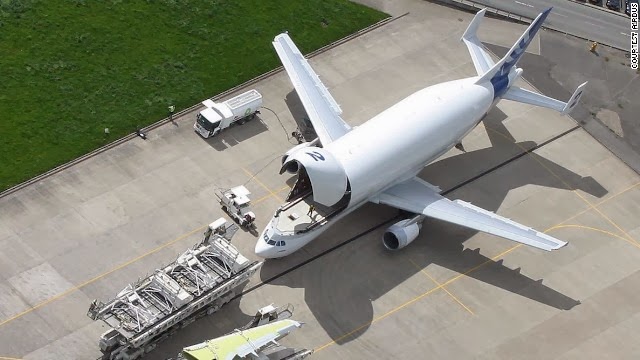
Airbus' Beluga: Inside the world's strangest-looking airplane

If there's ANYTHING known about Airbus, they make BIG flying machines.... Yes, take a good look at the Airbus Beluga, with the exception of the A380, this aircraft carries large sections of the Airbus family of aircraft into Toulouse, France for final assembly. 

STORY HIGHLIGHTS
  • Airbus' five Belugas are made to transport huge items, such as aircraft wings
  • The Beluga was designed to end Airbus' reliance on the Boeing Super Guppy
  • Airbus may be looking at a potential "Beluga XL" replacement
(CNN) -- If you ever find yourself in the French city of Toulouse, you might just see one of the oddest-looking aircraft in the world. Popularly known as the "Beluga," because of its strong resemblance to the white Arctic whale, the Airbus A300-600ST (ST stands for Super Transporter) is unique not only in appearance, but also for the essential role it performs in European aviation.

Airbus' production centers are scattered all over the continent, a legacy of its origins as a pan-European consortium.Each factory specializes in the completion of a specific section of an aircraft.

The five Belugas, all operated by Airbus, link these plants and take the different aircraft sections to the final assembly line, either in Toulouse or Hamburg.

The Beluga A300-600ST on Takeoff - Beluga #2 of the 5 in number 
The Beluga isn't serially produced, making each an "artisan" product. The A300-600ST Super Transporter can carry a payload of 47 metric tons (103,616 pounds) over a range of 1,500 nautical miles.

Frankenstein of cargo planes
Designing the Beluga wasn't easy. The top section of an Airbus A300-600 was cut off. A wider fuselage section was added, giving the plane its characteristic hump. The cockpit was lowered, allowing cargo to be loaded through the front of the aircraft.

A plane spotter's dream --- Wow. Beluga #3 

The legendary Beluga has brought many a plane spotter to Toulouse. Visitors can often be found sitting on the grass near Toulouse Blagnac Airport waiting for one of the five big beauties to take off or land.
Built for volume, not weight
With a diameter of 7.1 meters, the Beluga has an incredibly large cargo hold. Though its maximum payload of 47 tons is surpassed by only a handful of cargo aircraft, the hold makes it good for oversized but not particularly heavy cargo
Cockpit
The A300-600ST Super Transporter is operated by a crew of three: two pilots and a loadmaster.

Flying white whale - Spot the difference?
                                               
\


A300-600ST Super Transporter
The Beluga's jet speed and efficiency allows "for short transport times to meet strict production schedules," says Airbus. "A semi-automated main deck cargo loading system ensures easy and efficient handling of aircraft components." 


Sum of many parts


Aerial view


A Beluga can carry the wings of an A340 airliner or fuselage for Airbus' wide-body A350. It's not large enough to transport parts for the A380 super jumbo. Those travel by boat, barge and road. 


The Beluga's future
Airbus is looking at a potential replacement for the aging A300-600ST Super Transporter. Though no final decisions have been made, the "Beluga XL" is expected to have a longer range and ability to carry heavier payloads. 


Source


April 24, 2012

Jetstar Japan takes delivery of its first Airbus A320 aircraft


Jetstar Japan, one of Japan’s newest low-cost carriers (LCC), has taken delivery of its first Airbus A320 aircraft in Toulouse, France. The Japanese carrier will start commercial services in July operating from Narita to Kansai, Fukuoka, Sapporo, and Okinawa with an initial fleet of three aircraft. This fleet will grow to 24 aircraft within three years.

Jetstar Japan’s A320s are configured in a high comfort all economy layout with 180 seats. Each aircraft is powered by IAE V2500 engines.  

“We are extremely happy to take delivery of our brand new Airbus A320. With its wider seats and more spacious cabin than the competition, we are positioned to provide better value that our customers will appreciate as well as fast turnarounds, which is key to our business model,” Jetstar Japan President Miyuki Suzuki said. “We aim to become the number one LCC in the Japanese market, and the A320 will help us achieve our goals.” 

“We are delighted to welcome Jetstar Japan as our newest Airbus operator. The A320 has the widest most comfortable cabin and the best performance of any single-aisle aircraft. Passengers love it and operators love it too,” said Airbus Chief Operating Officer, Customers John Leahy. “The A320 is already the aircraft of choice in Asia with some 80 per cent market share in the LCC market.”

Jetstar Japan, established in 2011, is a joint venture between the Qantas Group, Japan Airlines (JAL), Mitsubishi Corporation and Century Tokyo Leasing Corporation. Jetstar Japan’s Airbus fleet is from an order for 110 A320 Family aircraft placed by the Qantas Group in October 2011.

As of today, nearly 8,400 Airbus A320 Family aircraft have been sold to more than 340 customers and operators worldwide, making it the world’s best selling commercial jetliner ever. With proven reliability and extended servicing periods, the A320 Family has the lowest operating costs of any single-aisle aircraft.


April 16, 2012

Airbus Starts Final Assembly of First A350 XWB


Photo Credit: Airbus Images
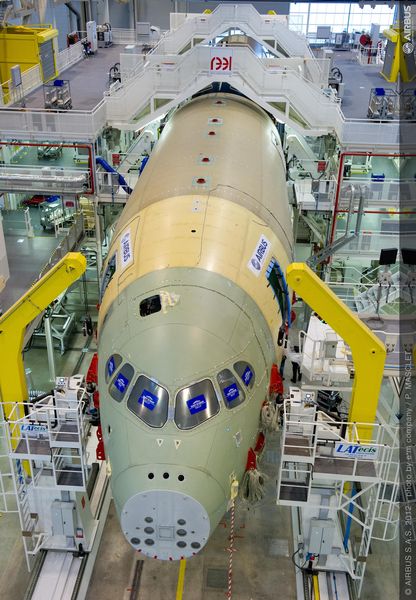
Final assembly of the first A350 XWB is now underway at the brand new final assembly line in Toulouse. This latest step in the A350 XWB’s progress is achieved as Airbus starts joining the 19.7 metre long centre fuselage with the 21 metre long front fuselage.

This first A350 XWB airframe will be used for the static structural tests that all new aircraft undergo as part of their certification process. The assembly of the first flying A350 XWB, MSN1, will start during summer.

The centre fuselage was delivered to Toulouse on Wednesday 4th April 2012 by Beluga from Airbus in St Nazaire, France. The front fuselage was previously delivered from St Nazaire to the A350 XWB final assembly line on the 23rd December 2011. Delivery and installation of the aft fuselage from Hamburg, Germany will take place in the coming weeks, followed by the wings delivered from Airbus’ wing assembly site in Broughton, UK.

Airbus Images
The A350 XWB fuselage is made up of three main sections - front, centre and aft. These will be joined together at the first main assembly station, Station 50. The nose landing-gear is also joined here. Once this stage is completed, the fuselage is transferred to Station 40 where the wings and tail sections are joined.  In parallel to this, cabin installation will be carried out simultaneously to the wing-fuselage join up, as well as the “power on” of the aircraft systems. In this way, functional tests can start earlier than on previous programmes. 

Airbus Images
The A350 XWB is Airbus’ all new family of mid-size widebody airliners. These highly efficient aircraft bring together the latest in aerodynamics, design and advanced technologies to provide up to 25 percent better fuel efficiency and operating costs compared to current aircraft in the same size category. Over 70 percent of the A350 XWB’s weight-efficient airframe is made from advanced materials combining composites (53 percent), titanium and advanced aluminium alloys. The aircraft’s innovative all-new Carbon Fibre Reinforced Plastic (CFRP) fuselage results in lower fuel burn as well as easier maintenance. The A350 XWB benefits from Airbus’ high level of expertise in incorporating composite material into its aircraft.

The A350 XWB Family consists of three passenger versions with true long-range capability of flying up to 8,500nm/15,580km. In a typical three-class configuration, the A350-800 will offer 270 seats while the A350-900 and the A350-1000 will offer 314 and 350 seats respectively.


Airbus Media


March 29, 2012

Airbus to exhibit corporate jet for first time in Shanghai


An Airbus ACJ318, the corporate jet version of the A318 airliner, will be the highlight of the company’s presence at the ABACE show, marking the first time that any of the company’s bizjets is exhibited in Shanghai.
The Airbus ACJ318 on display is operated by Abu Dhabi-based Al Jaber Aviation, which offers it for VVIP charters in a spacious and comfortable arrangement with seating for 19. 

“When companies, individuals and governments use corporate jets, such as the Airbus ACJ318, they empower their leaders to accomplish more, helping them to bring home new business, safeguard jobs, and contribute to overall economic growth,” points out Airbus COO, Customers, John Leahy. “With the widest and tallest cabin of any bizjet, Airbus corporate jets can also carry larger groups than traditional business jets,” he adds.
Airbus’ ACJ318 is similar in size externally to traditional large-bizjets, but has a cabin that is about twice as wide, delivering new standards in comfort, space, and freedom of movement.

It features lounge-style seating for passengers in several different zones, as well as an office with ensuite bathroom, which can be converted into a bedroom. The Airbus corporate jet on display at ABACE in Shanghai thus gives potential customers the chance to experience for themselves the best business jet cabin in the world. Airbus corporate jets are derived from the world’s most modern aircraft family, and offer the broadest range of sizes and ranges of any bizjet manufacturer, including VIP widebodies.

They have won some 170 orders since Airbus delivered its first corporate jet in the mid-Eighties, and are the only bizjets flying on every continent, including Antarctica. Airbus corporate jets have a widespread presence in Asia-Pacific, and especially China, which is one of the largest and fastest growing markets for business jets.

March 21, 2012

Airbus and Virgin Australia study new alternative fuel process


Airbus has joined a consortium including Virgin Australia to study a new pathway to produce sustainable aviation fuels. Eucalyptus mallee trees, grown in Western Australia’s wheat belt are sustainably harvested and converted to a feedstock for refining into alternative aviation fuel via a process called Pyrolysis.

Mallee is indigenous to Australia and is well adapted to the environment. It is a suitable sustainable crop because it helps return salt-affected land to a productive state. Mallee can be planted on farms alongside crops, and provide a range of environmental benefits and contribute to the long term sustainability of the overall farming operation. Growing these trees to make alternative fuels encourages large scale planting, which is expected to bring a range of environmental and social benefits to farmers and rural communities.   

The Pyrolysis thermal conversion process has yet to be recognized by the world’s fuels standards authorities. Airbus’ role includes supporting the approval and certification process so that Pyrolysis based fuels can be used for the first time in commercial aviation.

The consortium also includes Future Farm Industries CRC, which is developing sustainable farming systems as part of the Australian Government’s Cooperative Research Centres (CRC) program.
The project objective is to have a pilot alternative fuel production plant operating in Australia in the next year. The sustainability analysis is managed by the CRC, Airbus and the UK’s Manchester Metropolitan University.

“Alternative fuels are a crucial part of the roadmap for sustainable aviation and to help meet our ambitious CO2 reduction targets. We are privileged to be working with our Australian partners in this exciting value chain project,” said Tom Enders, Airbus President and CEO.

Virgin Australia Group Executive of Operations Sean Donohue said: “In order to produce a bio-fuel that can be used sustainably in our current aircraft, it is important to have members from every part of the supply chain involved. Airbus will bring vast expertise in aircraft manufacturing to the consortium and we are very pleased to have a company of its calibre joining this promising Australian project”.

The partnership agreement aims to develop a complete sustainable aviation bio-fuel production capability in Australia, using only sustainable resources and is part of the Airbus goal to have in place a value chain in every continent by 2012. So far Airbus has value chains in Latin America, Europe the Middle East, and now Australia.


March 15, 2012

India needs over 1,040 aircraft worth US$145 billion in next 20 years


Demand for larger Eco-efficient aircraft
 According to Airbus’ latest market forecast, Indian carriers will require 1,043 new passenger (1,020) and freighter (23) aircraft valued at US$145 billion between now and 2030 to satisfy surging annual demand. India’s market for new aircraft makes it the world’s fourth largest in both number of aircraft and value.
Indian annual passenger traffic growth rates of 7.2 per cent are well above the regional Asia Pacific average growth rate of 5.9 per cent and the world average 4.8 per cent.

Of the requirement for 1,020 new passenger aircraft, some 860 will be for growth and 160 to replace the eldest aircraft in the existing fleet of 327. By 2030, this means that India’s passenger fleet will more than triple to some 1,180 aircraft. The new passenger aircraft include 646 single aisles like the A320 and A320neo Family, 308 twin aisles like the A350 XWB and A330, and 66 very large aircraft such as the A380.

Growing urbanization and population concentrations combined with a growing middle class and dynamic economic growth are driving demand and this trend is expected to continue. Despite near term challenges, the Indian economy is forecast to continue expanding, helping India’s growth in domestic air travel to reach even higher growth rates of nearly 10 per cent annually, making it one of the fastest growing aviation markets anywhere in the world.

“By 2030, India’s economy is forecast to be the fourth largest in the world creating exceptional potential for growth in the aviation sector. Through our Indian industrial partnerships we are proud to boast that every A320 today is partly made in India,” said Dr. Kiran Rao, Airbus Executive Vice President, Sales and Marketing, and President of Airbus India. “Our engineering and industrial footprint in India supports over 2,000 highly skilled Indian jobs throughout our supply chain, and this figure is growing.”

Airbus’ partnership with India dates back almost 40 years. Today, half of all A320 forward doors and all flap track beams are produced in India. Established in 2006, the Airbus Engineering Centre India (AECI) in Bangalore employs over 270 highly skilled local engineers working in high end analysis and design on all Airbus products. The center is expected to grow to 450 over the next three years. Airbus recently established a second pilot training center in Noida (this one in cooperation with CAE and Interglobe) to complement the existing facility in Bangalore. Combined, they will have the capacity to train up to 5,000 pilots and maintenance engineers per year. Airbus’ market share of new aircraft orders in India is over 70 per cent.


March 14, 2012

I-4D receives the “Enabling Technology Award” for air traffic management excellence


The Airbus-developed I-4D (initial four-dimensional) system has been recognised for technological excellence by leading information provider IHS Jane's, underscoring its capabilities for improving the efficiency of air traffic management operations worldwide. I-4D - which is a cornerstone of the SESAR (Single European Sky ATM Research) programme - utilises a new-generation system for enhanced arrival flow management, improved flight punctuality and more capacity, and its first flight tests were completed in February using an A320 test aircraft. The "Enabling Technology Award" was received by Airbus and its partners Eurocontrol Maastricht and Noracon at the Canso Air Traffic Management dinner this month in Amsterdam.


Airbus Media

March 13, 2012

Airbus, Boeing both claim victory in latest round of WTO dispute


The ongoing transatlantic spat over government subsidies to Airbus and Boeing appears to have taken a turn against the US airframer. The World Trade Organisation has dismissed at least some of Boeing's appeal against a March 2011 ruling that found that it could not have launched an aircraft as sophisticated as the 787 for delivery as early as 2008 without subsidies that fall foul of WTO rules. That earlier ruling also found that the resulting quality of the 787 did serious damage to sales of the Airbus A330 and the original A350.

However, while the European Union suit against US support for Boeing claimed adverse subsidies amounting to $19.1 billion over the 1989-2006 period, the WTO appeals panel determined the value of the subsidies to be at least $5.3 billion. As at previous junctures in the two tit-for-tat disputes - the USA-Boeing originally filed a suit in 2004 against European governments for subsidizing Airbus, and the European side responded in kind - both sides are claiming victory in the WTO's latest pronouncement over billions of dollars of US federal and local taxpayer money spent to aid Boeing.

According to Airbus head of communications, Rainer Ohler, who stressed that the WTO has already found European governments' lending of A380 development funds to Airbus to be legal, today's ruling was a "sweeping loss for Boeing" that makes the 787 "the most heavily subsidised aircraft in aviation history".
Boeing, however, says that the ruling "slashed earlier findings of harm to Airbus from US subsidies", adding: "In sum, the WTO decisions in the two cases establish conclusively and finally that European subsidies competitively disadvantage Boeing and American workers and will continue to do so until launch aid is eliminated."

WTO rules now give Boeing and the United States, which is technically the respondent in this case, six months to comply. Meanwhile, Airbus and the European Union claimed on 1 December 2011 to have put themselves in compliance with the WTO ruling in the US-Boeing case against the EU-Airbus that some aspects of launch aid from France, Germany, Spain and the UK for the development of some earlier Airbus models should not have been allowed.

However, one lawyer familiar with the cases notes that unless the two sides either walk away from the dispute or press for resolution via a global agreement on airliner subsidies, the next likely series of moves will involve several years of compliance arbitration and subsequent appeals.

Flight Global

March 8, 2012

Malaysia Airlines provides first glimpse of A380 in new livery


Photo Credit: Flight Global
Malaysia Airlines (MAS) today revealed the design and specifications for its new A380, featuring a bright new livery and luxurious cabin layout. The aircraft will accommodate 494 passengers in a three class configuration, seating eight passengers in First Class, 66 in Business Class and 420 in Economy. All seats are fitted with the latest individual in-flight entertainment systems, USB ports and satellite telephone facilities.


Photo Credit: Flight Global

MAS Group CHief Executive Office, Ahmad Jauhari Yahya said, ' The A380 will showcase our latest premium offering in products and services. This will be our flagship aircraft to launch our exciting new levels of comfort, luxury and convenience in long haul travel'. Altogether, MAS has order six A380s. The carrier is set to become the eighth operator of the aircraft when it begins commercial service with the type between Kuala Lumpur and London in July.


Airbus Media 


Suggested posted related topics on Bio-Fuels, Green Initiatives, click below

Airbus to offer higher-weight A380 from 2013

THAI’s first A380 makes maiden flight from Toulouse


March 7, 2012

Airbus aims to hire at least 25 per cent women among its 4,000 new recruits in 2012


On International Women's Day (8th March) Airbus encourages more women to join the aeronautic industry.

Airbus, the worlds leading aircraft manufacturer, is committed to ensuring that at least 25 per cent of its new recruits in 2012 will be women despite the low number of women studying engineering subjects. With the aim to hire 4000 people worldwide this year, Airbus is calling for more women to apply for jobs in sectors that are traditionally seen as male dominated.

Airbus is developing women’s careers at all levels of the company with the objective to broaden its know-how and soft skills on managerial capabilities, by increasing the number of women in management positions. To support this, a number of specific actions have been introduced to prepare and promote women at different levels by identifying female talents and their career path through internal development programs such as mentoring, coaching, and leadership development amongst others.

“Airbus wants to attract more women and it is not simply about achieving quotas and targets. I am convinced that a more balanced proportion of women at all levels of the company can only improve Airbus’ performance”, explained Thierry Baril, Airbus Executive Vice President, Human Resources. “Offering equal chances is an essential corner stone of the Airbus corporate culture” he added. 

 Employing more than 55,000 people worldwide, of over 100 nationalities, Airbus is the leading aircraft manufacturer with design and manufacturing facilities in France, Germany, the UK, and Spain, as well as subsidiaries in the U.S., China, Japan and in the Middle East.
 
Some 4,500 new employees were recruited in 2011, driven by an order backlog equivalent to 7-8 years production and the continued development of aircraft programs such as A320neo (new engine option), and the A350 XWB Family. Airbus has sold close to 11,500 aircraft and delivered over 7,000 since its first airliner entered service. 

March 6, 2012

THAI’s first A380 makes maiden flight from Toulouse


Next phase will be cabin installation and aircraft painting

The first A380 for Thai Airways International (THAI) took off for its maiden flight on 5th March following completion of the airframe assembly and system tests in Toulouse, France.
After a successful flight of more than four hours, the aircraft landed in Hamburg, Germany, where it is entering the next phase of production, covering cabin installation and painting.
THAI will become the ninth operator of the A380 when it takes delivery of its first aircraft in the third quarter of 2012. The airline has firm orders for six A380s and will operate the aircraft on its premier routes from Bangkok to Europe.

Airbus looks to meet industry demand for more complex aircraft liveries


As aircraft liveries trend toward bolder and more intricate designs, Airbus is advancing development of an innovative computer-based system for effectively “printing” complicated graphics directly onto an aircraft’s surface. 

This high-potential technique – called direct printing – already has demonstrated its capabilities for the automotive and home appliance sectors, and is now being evaluated for use on Airbus’ fuel-saving Sharklet wingtip devices.

Not only is direct printing highly flexible in terms of reproducing colours or images, it also reduces the necessary thickness for coatings. This can be a major consideration, as the amount of dielectric coating per aircraft has direct implications related to overall weight, electrical static discharge and lightning strikes. In addition, the technique can lead to faster production times because it eliminates the need to mask and demask surface areas being painted.

“This project is exciting for us as we are the first aircraft manufacturer to consider using direct printing, and while we have more tests to perform, it is a very promising technology,” said Birgit Kuhlenschmidt of Airbus’ single-aisle product line paint shop in Hamburg, Germany, who is closely involved with the project.
Successful evaluations have been conducted at the supplier’s facility in Switzerland with a representative Sharklet wingtip device, while key lab tests for adhesion, hydraulic fluid resistance and flexibility already have been passed.


March 5, 2012

Qatar not in the market for acquisitions: Al Baker


Ailing airlines looking for a white knight need not trouble Qatar Airways. Chief executive Akbar Al Baker says the cash-rich carrier is no longer in the market to acquire airlines after its strategic investment in freight specialist Cargolux. "We were looking at potential acquisitions, but we are not any more," he says. "All the time people are knocking at our door. We are polite in telling them that we are not interested."

Airbus and Boeing are used to being kept on their toes by the outspoken Al Baker and both have been given a warning. Al Baker says Qatar Airways is still interested in the largest variant of the Airbus A350, the -1000, for which it holds 20 orders, but that the airline is still disappointed with the variant's performance figures. "Airbus are working to improve the aircraft, but I want to stress that as the aircraft is today, Qatar Airways is not happy." The airline has a further 60 commitments for the -800 and -900 versions of the A350.

Al Baker says he is confident of receiving the first of 30 Boeing 787-8s - the 53rd Dreamliner off the production line - in time to enter service shortly after being displayed in Qatar Airways colours at the Farnborough air show in July. But he warns that failure to deliver by this deadline will not be tolerated. "Boeing is aware that Qatar Airways will not accept any further slippage," he says.

He also said a potential acquisition of the Bombardier CSeries has been "shelved" but that Qatar Airways "will come back to it". Al Baker promised to introduce radical changes at Cargolux, in which Qatar Airways owns a 35% stake. "They have been in the cargo business for 25 years longer than we have. But it is important that the culture and the way the business is run happens in a different way. Times have changed but their business model has not. We want to bring in efficiencies and help them streamline by introducing them to our culture."

He said the immediate outlook for the cargo market remains gloomy, admitting that Qatar had invested in Cargolux at a "difficult time" for the sector. "Cargo is bad at the moment. Luckily we are not a major operator of freighters so we can weather the crisis. In the long term I expect it to improve, but in the short term, no," he said.

Flight Global