Showing posts with label Going-Green. Show all posts

January 19, 2014

Boeing Joins New BIOjet Abu Dhabi Team to Grow Biofuel Supply Chain in United Arab Emirates

- Collaboration focuses on research, feedstock production and refining capability

- Announcement follows Etihad 777 biofuel demonstration flight in Abu Dhabi

ABU DHABI, United Arab Emirates, Jan. 19, 2014 /PRNewswire/ -- Boeing [NYSE:BA], Etihad Airways, Takreer, Total and the Masdar Institute of Science and Technology today announced they will collaborate on a new initiative to support a sustainable aviation biofuel industry in the United Arab Emirates.
BIOjet Abu Dhabi: Flight Path to Sustainability will engage a broad range of stakeholders to develop a comprehensive framework for a U.A.E. biofuel supply chain. This initiative will focus on research and development and investments in feedstock production and refining capability in the U.A.E. and globally.

Boeing Joins New BIOjet Abu Dhabi Team to Grow Biofuel Supply Chain in United Arab Emirates.


Boeing, Etihad Airways, Takreer, Total and Masdar Institute of Science and Technology today announced they will collaborate on a new initiative, BIOjet Abu Dhabi: Flight Path to Sustainability, to support a sustainable aviation biofuel industry in the United Arab Emirates. Pictured here, Etihad Airways conducted a 45-minute demonstration flight on Jan. 18 with a Boeing 777-300ER (Extended Range), powered in part by the first sustainable aviation biofuel produced in the U.A.E.
Etihad Airways showed the promise of this homegrown effort yesterday with a 45-minute demonstration flight in a Boeing 777 powered in part by U.A.E.-produced sustainable aviation biofuel. The biofuel was partially converted from plants by Total and refined into jet fuel by Takreer, a wholly-owned subsidiary of Abu Dhabi National Oil Co. (ADNOC). U.A.E. is now among a handful of countries that have produced and flown on their own aviation biofuel, which emits at least 50 percent less carbon dioxide than fossil fuel over its lifecycle.
"In collaboration with our key partners, our goal is to support and help drive the commercialization of sustainable aviation fuel in Abu Dhabi, the region and also globally," said Etihad Airways President and CEO James Hogan. "We have made some important first steps in this process and our continued focus will be to develop further initiatives such as this which will facilitate the availability of sustainable aviation biofuels for Etihad Airways in the coming years."
Boeing and Etihad Airways are also among the founding partners of the Sustainable Bioenergy Research Consortium, hosted by the Masdar Institute in Abu Dhabi. The consortium has been researching and developing salt-tolerant plants that would be raw material for the same refining processes used to produce renewable fuel for the Etihad Airways flight.
The flight and BIOjet Abu Dhabi announcement lead into Abu Dhabi Sustainability Week and the World Future Energy Summit. These activities and Masdar Institute's aviation biofuel research are aligned with the Abu Dhabi Economic Vision 2030, which seeks to develop sustainable energy sources to diversify the U.A.E. economy and increase workforce opportunities for Emiratis.


"With further commitment and investment, the U.A.E., a global leader in commercial aviation, is well-positioned to lead efforts to make our industry more sustainable," said Jeffrey Johnson, president, Boeing Middle East. "Boeing works with partners around the world to advance sustainable biofuel development and sees great opportunity for BIOjet Abu Dhabi to have a positive impact in the U.A.E. and globally."
"Takreer is proud to have been involved in refining this aviation biofuel at its Abu Dhabi research center," said Takreer CEO Jasem Ali Al Sayegh. "We support the concept of using biofuel as a sustainable aviation fuel for a cleaner future in line with ADNOC's sustainability policy. We see this strategy as complementary to our future plans in meeting the rapid growth in demand for jet fuel in the country and the region in view of the expansion of the operations of airlines here."
Etihad Airways is an airline industry leader in supporting the development of lower-carbon renewable fuels. A member of the Sustainable Aviation Fuel Users Group (SAFUG), the airline operated the Gulf region's first biofuel flight in January 2011 with a Boeing 777 delivery from Seattle to Abu Dhabi powered by a blend of petroleum-based and certified plant oil-based jet fuel.
Boeing collaborates with airlines, research institutions, governments and other stakeholders to develop sustainable biofuel supply chains around the world, including the United States, Middle East, China, Brazil, Europe and Australia.
For more information, visit http://www.boeing.com/boeing/aboutus/environment/

Source - Boeing Media

March 22, 2012

Boeing, Airbus and Embraer to Collaborate on Aviation Biofuel Commercialization


GENEVA, March 22, 2012 /PRNewswire/ -- Boeing (NYSE: BA), Airbus and Embraer today signed a memorandum of understanding to work together on the development of drop-in, affordable aviation biofuels. The three leading airframe manufacturers agreed to seek collaborative opportunities to speak in unity to government, biofuel producers and other key stakeholders to support, promote and accelerate the availability of sustainable new jet fuel sources.

Boeing Commercial Airplanes President and CEO Jim Albaugh, Airbus President and CEO Tom Enders, and Embraer Commercial Aviation President Paulo Cesar Silva, signed the agreement at the Air Transport Action Group (ATAG) Aviation and Environment Summit in Geneva.

"There are times to compete and there are times to cooperate," said Jim Albaugh. "Two of the biggest threats to our industry are the price of oil and the impact of commercial air travel on our environment. By working with Airbus and Embraer on sustainable biofuels, we can accelerate their availability and reduce our industry's impacts on the planet we share."

"We've achieved a lot in the last ten years in reducing our industry's CO2 footprint - a 45 percent traffic growth with only three percent more fuel consumption," said Tom Enders. "The production and use of sustainable quantities of aviation biofuels is key to meeting our industry's ambitious CO2 reduction targets and we are helping to do this through Research and Technology our expanding network of worldwide value chains and supporting the EU commission towards its target of four percent of biofuel for aviation by 2020."

"We are all committed to take a leading role in the development of technology programs that will facilitate aviation biofuels development and actual application faster than if we were doing it independently," said Paulo Cesar Silva. "Few people know that Brazil's well known automotive biofuels program started within our aeronautical research community, back in the seventies, and we will keep on making history."

The collaboration agreement supports the industry's multi-pronged approach to continuously reduce the industry's carbon emissions. Continuous innovation, spurred by competitive market dynamics that push each manufacturer to continuously improve product performance, and air traffic modernization, are other critical elements to achieving carbon-neutral growth beyond 2020 and halving industry emissions by 2050 based on 2005 levels.

"Having these three aviation leaders set aside their competitive differences and work together in support of biofuel development, underscores the importance and focus the industry is placing on sustainable practices," said ATAG Executive Director Paul Steele. "Through these types of broad industry collaboration agreements, aviation is doing all it can to drive measurable reductions in carbon emissions, while continuing to provide strong global economic and social value."

All three companies are affiliate members of the Sustainable Aviation Fuel Users Group (www.safug.org), which includes 23 leading airlines responsible for approximately 25 percent of annual aviation fuel use. Boeing and Embraer are already collaborating on how to establish a sustainable aviation biofuels industry in Brazil and exploring new technology pathways to broaden biofuel sourcing and availability. Boeing and Airbus are also active around the globe in helping to establish regional supply chains, while the three manufacturers have all supported numerous biofuel flights since global fuel standards bodies granted their approval for commercial use in 2011.

PR Newswire

March 21, 2012

Airbus and Virgin Australia study new alternative fuel process


Airbus has joined a consortium including Virgin Australia to study a new pathway to produce sustainable aviation fuels. Eucalyptus mallee trees, grown in Western Australia’s wheat belt are sustainably harvested and converted to a feedstock for refining into alternative aviation fuel via a process called Pyrolysis.

Mallee is indigenous to Australia and is well adapted to the environment. It is a suitable sustainable crop because it helps return salt-affected land to a productive state. Mallee can be planted on farms alongside crops, and provide a range of environmental benefits and contribute to the long term sustainability of the overall farming operation. Growing these trees to make alternative fuels encourages large scale planting, which is expected to bring a range of environmental and social benefits to farmers and rural communities.   

The Pyrolysis thermal conversion process has yet to be recognized by the world’s fuels standards authorities. Airbus’ role includes supporting the approval and certification process so that Pyrolysis based fuels can be used for the first time in commercial aviation.

The consortium also includes Future Farm Industries CRC, which is developing sustainable farming systems as part of the Australian Government’s Cooperative Research Centres (CRC) program.
The project objective is to have a pilot alternative fuel production plant operating in Australia in the next year. The sustainability analysis is managed by the CRC, Airbus and the UK’s Manchester Metropolitan University.

“Alternative fuels are a crucial part of the roadmap for sustainable aviation and to help meet our ambitious CO2 reduction targets. We are privileged to be working with our Australian partners in this exciting value chain project,” said Tom Enders, Airbus President and CEO.

Virgin Australia Group Executive of Operations Sean Donohue said: “In order to produce a bio-fuel that can be used sustainably in our current aircraft, it is important to have members from every part of the supply chain involved. Airbus will bring vast expertise in aircraft manufacturing to the consortium and we are very pleased to have a company of its calibre joining this promising Australian project”.

The partnership agreement aims to develop a complete sustainable aviation bio-fuel production capability in Australia, using only sustainable resources and is part of the Airbus goal to have in place a value chain in every continent by 2012. So far Airbus has value chains in Latin America, Europe the Middle East, and now Australia.


March 6, 2012

Boeing, COMAC Sign Collaboration Agreement to Partner in Areas Adavncing Commercial Aviation Industry Growth


  • Boeing and COMAC Create Aviation Energy Conservation and Emissions Reductions Technology Center in Beijing
  • Aircraft Manufacturers Strengthen Ties with Leadership Meetings, Exchange of Commercial Aviation Market Forecasts
BEIJING, March 6, 2012 /PRNewswire/ -- Commercial Aircraft Corp. of China (COMAC) and Boeing (NYSE: BA) today announced a collaboration agreement to partner in areas that will enable commercial aviation industry growth in China and potentially around the world. This is the first collaboration agreement between COMAC, which is building the new C919 jet and ARJ21 regional jet, and Boeing, which this year celebrates its 40th anniversary of providing commercial aircraft and services to China's aviation industry.

As part of the agreement, the two companies will create the Boeing-COMAC Aviation Energy Conservation and Emissions Reductions Technology Center in Beijing. Funded by both companies, the Boeing-COMAC Center will support research projects to increase commercial aviation's fuel efficiency and reduce greenhouse-gas emissions. The aircraft manufacturers also agreed to have annual leadership engagements and exchange commercial aviation market forecasts.

A signing ceremony in Beijing was attended by COMAC Chairman Jin Zhuanglong, COMAC President He Dongfeng and Boeing Commercial Airplanes President and CEO Jim Albaugh.
"Through this collaboration agreement, Boeing and COMAC will build our relationship and will further sustainable growth and fuel efficiency for China's fast-growing aviation market," said Albaugh. "Our new Technology Center shows that two companies in a competitive industry can partner to make progress on important challenges that cannot be solved by one company alone. That is good for customers and passengers, and it's the right thing to do."

The Boeing-COMAC Aviation Energy Conservation and Emissions Reductions Technology Center will be located at COMAC's Beijing Civil Aircraft Technology Research Center. The companies will collaborate with China-based universities and research institutions to expand knowledge of technologies – such as sustainable aviation biofuels, aviation connectivity infrastructure and other areas – that improve commercial aviation's energy efficiency or reduce the industry's carbon emissions. The companies will jointly select and fund each research project.

"This milestone agreement between Boeing and COMAC follows four decades of Boeing partnership with airlines, government agencies, suppliers and research institutions to support the development of China's aviation industry," said Marc Allen, President of Boeing China. "Our hope is that innovative emissions-reduction technologies developed through the Boeing-COMAC Center will advance aviation in China and around the world."

China is one of the world's fastest-growing aviation markets. The Civil Aviation Administration of China has forecast that passenger traffic in China will surpass 300 million this year and will reach 1.5 billion passengers in 2030. Boeing has estimated that Chinese airlines will need to buy 5,000 new airplanes by 2030 to meet this extraordinary demand.

Boeing Media 


Suggested posted related topics on Bio-Fuels, Green Initiatives, click below


Lufthansa A321 passenger flights demonstrate the practicality of bio-fuels 

TaxiBot set to usher in a new era of airport taxiing

Airlines turn to alcohol as potential jet fuel replacement

February 21, 2012

Airlines turn to alcohol as potential jet fuel replacement


Alcohol may be known as the demon drink but a growing number of people are billing alcohol-to-jet (ATJ) fuel as having the potential to save the aviation industry from its dependence on fossil fuel. As with any movement, though, there are staunch and vociferous critics who doubt the reality of such claims.

Those in favour of ATJ fuels point to the wide availability of feedstocks - principally sugarcane - that can be fermented and distilled into ethanol and subsequently converted into jet fuel. This, say proponents, means it has a much better chance of being scaled up to commercially viable quantities once certificated than other alternative fuels that have already received the ASTM International stamp of approval.

Critics, however, argue that the amount of energy needed to convert these feed-stocks into the end-product cancels out the environmental benefits of burning ATJ fuels when the whole life cycle is taken into account. Opponents also doubt claims that the cost of ATJ fuels can be reduced to compare with the cost of kerosene any time in the near future.

HEAVYWEIGHT SUPPORT

Despite such criticism, airlines such as Virgin Atlantic and Qatar Airways have thrown their weight behind companies developing ATJ fuels, as has the US Department of Defense, which is in the process of trialling ATJ fuels produced by global chemicals company Gevo. Each company developing ATJ fuels adopts a slightly different process or feedstock, but they are all unified in their belief ATJ fuels will be approved for commercial use by certificating body ASTM International within two years and, following that, can be rapidly scaled up.

One such company is California-based Byogy Renewables, which claims to have produced the world's first 100% replacement for kerosene by bolting on its own back-end process to an ethanol plant to convert the ethanol into jet fuel via catalytic synthesis. "We've invented a process that converts alcohol to jet fuel. Most companies take the alcohol to someone else to turn into jet fuel," says Byogy chief executive Kevin Weiss. "This is a 100% replacement jet fuel from the most abundant feedstock in the world - sugar."

But the abundance of sugarcane as a feedstock is questioned by Stephen Bowers, a Germany-based specialist in evaluating feedstocks for petrochemical production. "Is sugar viable as a feedstock? In my opinion, no. The lowest cost of sugar production will come from cane sugar grown in a tropical climate [such as] Brazil," says Bowers.
"Global sugarcane production is close to two billion metric tonnes and Brazil is about 650-700 million tonnes per annum. In theory, Brazil could produce about 55 million tonnes of ethanol if all the sugarcane was processed into ethanol. On a global scale, sugarcane could produce 150 million tonnes of ethanol. Global jet fuel demand is something like 200 million tonnes and rising," Bowers adds.

Weiss believes the key advantage ATJ fuels have over fuels derived from hydroprocessed esters and fatty acids (HEFA) - which were certificated for commercial use by ASTM International on 1 July 2011 and have since been used to partially power commercial flights by a number of airlines - is that they do not have to be blended with kerosene because they already contain aromatics.

"HEFA fuels require massive hydroprocessing - the fuel has to be taken to an oil refinery. We're completely different - the fuel is made at our site and is ready for distribution at a fraction of the cost," he says. Weiss is hopeful ASTM certification for ATJ fuels can be achieved by the end of 2013 or the middle of 2014. "It's not a matter of if ATJ will get approved, it's a matter of when."

Qatar Airways has signed an agreement with Byogy to use its fuel once certificated. The selection of ATJ fuel and Byogy followed a year-long feasibility study by Qatar Airways "to see what kind of technologies are out there and what feedstocks are available locally and globally, and to find out if biofuels for aviation are feasible", says the airline's senior manager of corporate responsibility, environment and fuel optimisation, Chris Schroeder.
The feasibility study led Qatar Airways to believe "ATJ is probably going to be the frontrunner when it comes to biofuel for aviation", says Schroeder. "We engaged with Byogy 18 months ago and we threw our weight behind them. We wanted to push for ATJ with aromatics because we're looking in future to possibly blend it with GTL [gas-to-liquid fuel], which contains no aromatics."

In 2009, Qatar Airways operated a commercial flight between London Gatwick and Doha using an Airbus A340-600 with all four Rolls-Royce Trent 500 engines powered by a 50:50 blend of GTL and Jet A1 kerosene. The airline has teamed up with Qatar Petroleum and Shell, which have built a GTL plant in the gulf state. Schroeder says the carrier has received a "very, very promising" sample of ATJ fuel from Byogy. "We have signed an off-take agreement with them whereby whatever fuel they produce, once certified, we'll take it for the next couple of years. So with that, they can go into the venture capital market and raise capital."
Schroeder believes ATJ will be "the mainstay" of alternative fuels for aviation because "the feedstock is there in large quantities and certification is nearly there". However, he admits the industry is "in its infancy" and it will be a long time before ATJ can be scaled up to such a level it makes a significant impact on aviation's carbon footprint.

GRAVE RESERVATIONS
"It will be at least another decade and even then it will not be close to 5% or 8% of jet fuel because aviation is growing and this [growth] will slow everything down," says Schroeder.
Bowers has "grave reservations" about Byogy's claims, accusing the company of "pinning their technology to some magic breakthrough in cellulosic ethanol technology to somehow bring the price down to economic levels". While Schroeder says that "on paper the figures look good" and the price of Byogy's fuel "is relatively close to what we're paying for jet fuel", he admits that "until we really go into production, we don't know".

Read More  @ Source: Flight Global

February 17, 2012

TaxiBot set to usher in a new era of airport taxiing


 Part of Airbus Green Initiative 
 
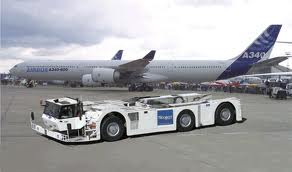
The need to use an aircraft’s main engines during ground taxi at airports may be eliminated with the innovative new “TaxiBot” tractor, which currently is under development by Israel Aerospace Industries (IAI) in close cooperation with Airbus.
 
This new-generation solution features a cockpit-operated driving system controlled by the pilot, which would be utilized after the aircraft has completed its typical “push-back” from an airport’s gate with a driver.  The TaxiBot’s application opens the way for more efficient taxiing – with benefits that include reductions in fuel consumption and CO2 emissions; lower air and noise pollution; and increased ground traffic safety.

Intended to be compatible with Airbus and other aircraft, there will be two vehicles: one capable of handling single-aisle airplanes sized at 100 seats and above, and the second for larger wide-body jetliners.
The response to TaxiBot from airlines, airports and aircraft leasing companies has been extremely positive, according to Heino Hoermann of Airbus’ Business Development office – who is managing the project.  “TaxiBot fits our strategic requirements and that of potential customers,” he added. “They see it as a near-term solution to reduce fuel consumption, which also fits with their environmental agenda.”

Featuring a diesel engine and electrically-driven wheels, TaxiBot is powerful enough to tow a fully-loaded aircraft. In addition, a load alleviation system limits the loads and stress on the towed aircraft’s nose landing gear and airframe. 

Pending the successful completion of TaxiBot's technical feasibility, a prototype for single-aisle aircraft will enter the test phase this coming spring. The aircraft and tug coupling evaluations and tug qualification are to be performed at France’s Chateauroux airport using a leased A320 jetliner.

A dedicated joint venture of Airbus and IAI is expected to be created in 2012 to finish the TaxiBot’s development and to commercialise the system. The first TaxiBot prototype was presented during October 2011 at the Inter Airport Europe exhibition in Germany, where it won an innovation award in the “interRAMP” category.

February 15, 2012

Airbus "talks the talk" on environmental efficiency


Airbus’ commitment as a leader in reducing the air transport industry’s environmental impact is being highlighted during daily presentations by company managers at the Singapore Airshow’s “Green Pavilion” exhibit.
Its corporate strategy – which is based on a life-cycle approach encompassing the full spectrum from design, manufacturing, operations and supply chain involvement to the responsible disposal of aircraft at end-of-life – is detailed in briefings held at 15h30 at the main exhibit hall’s Green Pavilion. 

Included in the daily presentation is information on Airbus’ blue5 programme, which is drawing a roadmap for reducing the environmental footprint of Airbus own operations by the year 2020.  Its targets include a 30 percent reduction in energy consumption; 50 percent reductions in CO2 emissions, VOC (volatile organic compound) emissions, and waste/water production; along with an 80 percent reduction in water discharge.

One very visible example Airbus’ steps that will contribute to its blue5 programme’s goals is the company’s newest final assembly line in Toulouse, France, which currently is gearing up for A350 XWB production.  This is the “greenest” of any final assembly facility built by Airbus, and it makes extensive use of natural lighting for reduced electricity consumption, while half of the flat roof surface (22,000 sq. meters) is fitted with photovoltaic solar panels.  As a result, the building will produce 55 percent of its own energy needs.