Showing posts with label VLJ. Show all posts

January 29, 2014

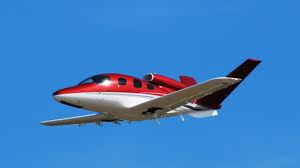
Cirrus poised to fly first Vision SF50


Cirrus Aircraft’s ambition to be the first to market with a single-engined personal jet looks set to become a reality, as it prepares its Vision SF50 prototype for first flight next month. The certification aircraft, C-Zero, will be used for flight performance verification. The two remaining test aircraft – C-One and C-Two – are scheduled to enter service in the second and fourth quarter, and will be used for systems verification and parachute testing, respectively.

An earlier configuration "technology demonstrator" – dubbed V1 – has accumulated around 800 flying hours and 1,000 engine runs since it was built in 2008. However, the new prototypes are more reflective of the production jet, says Cirrus executive vice-president of sales marketing Todd Simmons.
"The purpose of V1 has been to verify and validate the Vision jet design," Simmons says. "C-Zero is the summation of everything we have learned from V-1. For example, we have slightly changed the size and shape of the ruddervators, stabilisers, tail arm and the wing root junction.

"We have also made slight changes to [the] aerodynamic shape of the fuselage, [the] engine mount and its position on the aircraft, along with the interior. To the casual observer C-Zero will not look any different to V1."
The Vision has been a key focus for Cirrus since its launch more than seven years ago. Even during the economic crisis and the funding shortage that ensued, the Duluth, Minnesota-based airframer continued to work on the programme – albeit on a piecemeal basis.

The acquisition of Cirrus in 2011 by China Aviation Industry General Aircraft gave the programme new momentum. "CAIGA has committed $100 million to bring the Vision to market," Simmons says. "We are on track to certificate and deliver the first aircraft in 2015."

The $1.96 million Vision is equipped with a Garmin G3000 cockpit and an emergency parachute system. Powered by a Williams International FJ33 turbofan, the aircraft has a range of 1,200nm (2,220km), a stall speed of 61kt and a cruise speed of 300kt (556km/h).

Cirrus has secured 550 orders for the Vision to date – each with a $100,000 deposit. "Our customers range from [Cirrus] SR22 piston single operators to owners of high performance piston twins and single-engined turboprops, all wanting to move to a jet platform," says Simmons.

 "Our position holders come from across the globe, so once we have secured US approval we will get to work [certificating] the aircraft in the countries where our customers are based." Cirrus plans to offer a dedicated training programme to enable customers to secure their Vision type rating.


Comment: The SF50 is among the league of Very Light Jets (VLJ's) and it is scheduled to enter into service soon. A  few other entrants like the Honda Jet is anticipatory scheduled for entry into service in third/fourth quarter of 2014, however, there are few in operation such as the 

Eclipse 500 from Eclipse Aviation 
Embraer 100 and 500 from Brazil's Embraer 
Citation Mustang from Cessna 


Flight Global


April 24, 2012

Differences between the D-Jet and SF-50


Comparisons between both VLJs.

This information was taken from their different websites, please keep in mind that these information are subject to changes according to the OEM policies.


D-Jet  SF-50
Airframe Carbon Fiber Composites/Aluminum 
Power Plant  Williams FJ33-5A turbofan Williams FJ33-5A turbofan
# of Pax  2+3 2+3-5
Max Ramp Weight  5,690 Lbs  6,060lbs
Maximum Takeoff Weight  ??? 6,000lbs
Empty Weight  ??? 3,700lbs
Useful. Load 2,240 Lbs  2,300lbs
Maximum Payload  ??? 1,200lbs
Maximum Fuel  1,740Lbs  1960lbs
Max Cruise Speed 315ktas  300ktas
Long Range Cruise Speed  240ktas ???
Max Range 1,350nm  1430nm
Certified Ceiling  FL250 FL280
Time to Clime to FL250 15mins  ???
Time to Clime to FL250 (FPM) 1,667 ???
Takeoff   ??? 1,615
Landing ??? 1,245
Price  1.38 1.72


AERO 2012: Personal jets competition builds up steam as funding flows in


Cirrus Aviation - SF 50 VLJ
Competition is hotting up in the nascent personal jet race with both contenders - Cirrus and Diamond - hoping to cross the finishing line with their respective jets, Vision SF50 and D-JET, within three years.
"Now we have been given the funding by our new owner CAIGA [China Aviation Industry General Aircraft], we plan to bring the aircraft to market within three years," says Cirrus vice-president and managing director of international sales, Ian Bentley, at the show in Friedrichshafen, Germany.

CAIGA bought the company, which is based in Duluth, Minnesota, last year, and has injected $100 million into the program, on top of the $45 million invested by its former owner. Bentley said the SF50 has been a key focus for Cirrus since its launch six years ago. Although the company was forced to slow development throughout the downturn due to a funding shortage, work on the seven-seat aircraft has continued, albeit at a low level. The non-conforming prototype has completed more than 600 flying hours and Cirrus has carried out "detail design, systems verification and full flight envelope testing since then", adds Bentley.

Diamond D-Jet
"We are now building the tooling for the first of three production-conforming aircraft, which should take to the skies for the first time in 15 months," he says. About 500 orders have so far been secured for the $1.72 million aircraft - which is set for a price hike on 1 July to $1.96 million.

"Our D-Jet will enter service a year earlier than the SF-50," says Diamond Aircraft chief executive Christian Dries. The programme - which is managed by Diamond's Canadian subsidiary - received a large chunk of investment last year from an undisclosed source.

Earlier in the same year the company suspended development of the five-seat aircraft after the Canadian government denied a $35 million loan that was to be matched by Ontario province. Dries says about $80 million is needed to bring the $1.9 million aircraft into serial production, but he says all the engineering issues and risks have been resolved. "If I had know seven years ago how difficult it would be to develop a single-engine jet, I wouldn't have done it," he concedes.

Meanwhile, Dries revealed a glimpse of Diamond's new unmanned medium twin-engine helicopter. Called Heros - Helicopter Robotic System - the 600kg (1,323lb) aircraft is targeted at the civilian and military airborne sensor and reconnaissance markets and is being developed in partnership with an unnamed company.

"Heros will fly autonomously with a degree of artificial intelligence and flight judgement," says Dries. "For example, in the event of an engine failure, the aircraft will be capable of analyzing and picking the best landing spot before entering an auto rotation approach and touchdown," he adds.

Heros is powered by two Austro AE55 engines - developed by Diamond's sister company - and is also fitted with a parachute. Diamond has received "a lot of global interest in the aircraft", which is poised to enter formal flight testing.


Flight Global 


Differences Between D-Jet and SF-50

April 19, 2012

AERO 2012: Cirrus vision for SF50 to become reality 'in 2015'


Cirrus Aircraft has been given the go-ahead by its new owner to accelerate development of the Vision SF50 personal jet. China Aviation Industry General Aircraft (CAIGA), which acquired the Duluth, Minnesota-based general aviation manufacturer last year, has pledged $100 million to bring the seven-seat, single-engined aircraft to market.

"This should be within three years," says Ian Bentley, Cirrus vice-president and managing director of international sales. "We have been committed to this program since its launch over six years ago. When the economic downturn struck we were forced to slow development considerably, but even throughout this turbulent period we have been working at a low level to iron out any potential technical problems that we might encounter during the SF50 certification process."

Cirrus has already invested more than $45 million in the SF50, which made its first flight in July 2008. The non-conforming prototype has completed more than 600 flying hours to date, and Cirrus has carried out "detail design, systems verification and full flight envelope testing since then", adds Bentley.

Cirrus is now building the tooling for the first of three production-conforming aircraft, which should take to the skies for the first time in 15 months. "A handful of minor modifications will be incorporated in the production aircraft. For example, the cabin will be sightly wider and the sweep on the tail will be slightly reduced, says Bentley.

Cirrus has clocked up 500 orders for the Vision. "In 2008 we had around 400 orders. When the program was slowed we lost around 100 of these but have since added another 200, of which around 60% are from US-based customers," says Bentley.

The SF50 has a cruise speed of 300kt (555km/h) and a range of 1,000nm (1,850km). The aircraft is priced at $1.72 million until 30 June, when it will rise to $1.96 million. Cirrus plans to manufacture 75 Visions in the first year of production, "rising to a steady production rate of 125 aircraft a year", says Bentley.


Flight Global

March 15, 2012

Cessna M2 makes its maiden flight


Photo Credit: Cessna Aviation
Cessna's latest Citation business jet, the M2, took to the skies for the first time on 9 March. The flight, from Cessna's facility in Wichita, Kansas, lasted around 1h 30min during which the light cabin jet's G3000 avionics, autopilot, instrument approaches, engine and aircraft systems were tested. The Williams International FJ44-powered twinjet is based on the out-of-production CJ1 (Model 525) featuring a 400kt (740km/h) maximum cruise speed. The eight-seat M2 is priced at $4.2 million.


Flight Global

February 17, 2012

Embraer Achieves 300th Phenom Jets Delivery


Melbourne, Florida, USA – Embraer recently delivered the 300th Phenom jet, capping off the latest series of milestones which includes the assembly and first flight of the initial aircraft from the Company’s year-old Melbourne facility in Florida, USA. Embraer recently shifted global operations for its business jets from Brazil to Melbourne, where it is creating 200 engineering and technical jobs in an area hard hit by reductions in the Space Shuttle program.

“With the delivery to a US customer of a Phenom 300 jet, the 300th delivery in the Phenom line, Embraer has achieved a true milestone,” said Robert Knebel, Vice President Sales for North America, Embraer Executive Jets. “The success of the Phenoms can be seen in the diversity of our customers, which include private individuals, corporations, universities, fractional, charter, flying schools and motor racing executives. Fifty percent of the Phenom deliveries have been taken by North American customers, with Latin American operators accounting for another 30%. Europe, the Middle East and Africa (EMEA) account for 17%, while Asia accounts for 3% of the market.”

Deliveries have been building since December 2008, when the Phenom 100 entered in service. In 2009, deliveries rose to 98, along with another 126 in 2010. In 2011, there were 83 deliveries.

Since 2000, Embraer has not only entered the dynamic executive jet market, but has also fielded seven different designs, covering the entry level business jet represented by the Phenom100 to the ultra-large executive jet represented by the Lineage 1000. The Phenom jets represented the first clean-sheet designs, an innovation for the light jet segments in the industry, which has suffered from the continuous introduction of derivative products.

The Phenom 100 can accommodate up to eight occupants and has seven different interior options designed in partnership with BMW Group DesignworksUSA. Its range of 1,178 nautical miles (2,182 kilometers), including NBAA IFR fuel reserves, means the aircraft is capable of flying nonstop from New York to Miami, in the U.S.; from London to Rome, in Europe; or from Brisbane to Melbourne, in Australia. The jet has proved to be the fastest, with the largest baggage capacity in the entry level category. It has the latest in cockpit design, and a private aft lavatory is one of its competitive features.

The Phenom 300 reaches 521 mph (839 km/h, or 453 knots - KTAS) and can fly at an altitude of up to 45,000 feet (13,716 meters). Its range of 1,971 nautical miles (3,650 kilometers), including NBAA IFR fuel reserves, means the aircraft is capable of flying nonstop from Zurich to Reykjavik (Iceland), Las Palmas (Gran Canaria, Spain), Moscow (Russia) or Cairo (Egypt).

Embraer Media 

The Phenom 100 and 300 are VLJ's (Very Light Jets - Jets that are "single-pilot" operated AND have a Maximum Takeoff Weight (MTOW) of 10,000lbs or less ).