January 27, 2014

Airbus welcomes A380 operations in India


  • Indian Ministry of Civil Aviation approves A380 operations in India


Airbus welcomes the news that the Indian Ministry of Civil Aviation has approved the operations of the Airbus A380 in India.

“This is good news for Indian airports and the Indian flying public. The A380 is the world’s most fuel efficient aircraft in service with the lowest operating costs per seat and the highest revenue generating potential which benefits the airlines and the travelling public. For the Indian flying public, the A380 offers the world’s most comfortable flying experience,” said Dr. Kiran Rao, Airbus EVP Strategy and Marketing.

                                                                 Photo credit: Airbus images
A booming economy, a growing middle classe, migration, urbanisation and tourism are all factors pushing India to become one of the world’s fastest growing aviation markets.  Larger aircraft like the A380 combined with higher load factors make the most efficient use of limited airport slots and contribute to rising passenger numbers without additional flights to capture this growth.

As recently confirmed by London’s Heathrow Airport, Europe’s busiest A380 airport, the Airbus A380 lets airports maximise efficiency and revenue potential by offering more passenger seats with the same number of flights.

The A380 is the world’s quietest large aircraft inside and out, making less than half the noise of its nearest rival around airports. In recognition of this, in 2012 the A380 won an award from the UK’s Noise Abatement Society for its quiet operations. It is also one of the greenest aircraft, with unmatched fuel efficiency.

So far, over 120 A380s have been delivered to 10 of the world’s leading airlines. Over 50 million passengers have enjoyed the A380 flying experience and the fleet has accumulated some 150,000 flights and over 1.2 million flight hours. The A380 has visited nearly 160 airports of all sizes and in all continents of the world.

Lion Air to convert 787 order into narrowbodies


Lion Air plans to convert its order for five Boeing 787 aircraft into narrowbodies, says its president director Rusdi Kirana. It will likely be converted into Boeing 737s. Kirana explains that the slots constraints in Indonesia, especially out of Jakarta, means that airlines require jets bigger than the 787. He would not list the widebody aircraft types the group is evaluating, but says that Lion has plans to add widebodies to its fleet as part of its domestic expansion plans.


Airbus forms a sustainable fuel Centre of Excellence in Malaysia


  • Partnership aims to promote local production of sustainable jet fuels

Airbus and key Malaysian partners have signed a Memorandum of Understanding (MoU) to assess local solutions for sustainable bio-mass production in Malaysia.  The aim is to determine the most suitable feedstocks to ensure that any future jet fuel production in the region is based only on sustainable solutions. The first assessment is expected to be completed by December 2014.

Other partners include AMIC (Aerospace Malaysia Innovation Centre), MiGHT (Malaysian Industry-Government Group for High technology), UPM (Universiti Putra Malaysia), CIRAD (a French research centre working with developing countries to tackle international agricultural and development issues) and BioTech Corp (Malaysian Biotechnology Corporation).

The science advisor to the Prime Minister of Malaysia, chairman of MIGHT, BioTech Corp and AMIC, Prof Emeritus Dato’ Sri Dr. Zakri bin Abdul Hamid, said "The Centre of Excellence will help us to improve the understanding of the nature of aviation biofuel commercialisation in Malaysia, to identify the opportunities and challenges, and to evaluate the possibility of social, economic, market and technology change and its cost, obstacles and challenges.”

“We believe that the research will have positive effects on energy conservation and CO2 emissions reduction in the Malaysian and South-East Asia aviation sector", said Prof. Datuk Dr. Mohd Fauzi Hj Ramlan, Vice Chancellor of UPM.

“South-East Asia is a wide and productive region in terms of biomass. The creation of a Centre of Excellence in Malaysia, with local partners is an opportunity to ensure that any selected bio-mass satisfies strict sustainability criteria”, said Frédéric Eychenne, Airbus New Energies Programme Manager. “According to our latest Global Market Forecast, Asia-Pacific will lead in world traffic by 2032.Today’s MoU is part of our engagement to support traffic growth whilst reducing aviation’s footprint on the environment”.  

Airbus supports the certification and development of commercial quantities of sustainable alternative fuels for aviation through promoting innovative regional projects world-wide. To date, Airbus has formed partnerships in Europe, America, Australia, Middle-East and China.

Airbus is a leading aircraft manufacturer offering a complete range of aircraft families, from 100 to well over 500 passenger seats, as well as the most modern, comprehensive and fuel-efficient product line on the market. 


January 25, 2014

Milestone reached with final truss lifted into place


Photo Credit: Airbus Images 
With the placement of the final truss atop the roof this week, the construction of the first building in the Airbus Mobile Assembly Line complex has reached an important milestone. The entire “skeleton” of the building can now be seen. 

This building is the Final Assembly Line Hangar, which is where A320 family aircraft will be assembled. The milestone was celebrated with the construction crew and project team members signing the final truss before it was lifted into position.  

Construction contracts for the other buildings in the complex will be awarded soon. Aircraft assembly is scheduled to begin in 2015, with first deliveries from the Mobile facility beginning in 2016. Airbus anticipates the facility will produce between 40 and 50 aircraft per year by 2018.


Another milestone I must say, however, if Airbus is to keep up to pace with delivery, they need to ramp up production. Assembly of 40 to 50 aircraft per month as compared to Boeing isn't really competitive, that's about 2.5x to 3x the amount. While quality is imperative, speed shouldn't be undermined. 

Boeing Rolls Out First 787 Dreamliner at Increased Production Rate


  • Program achieves 10 per month rate, highest ever production for a twin-aisle airplane

EVERETT, Wash., Jan. 24, 2014 /PRNewswire/ -- Boeing (NYSE: BA) has rolled out the first Boeing 787 Dreamliner built at the rate of 10 airplanes per month. The airplane, a 787-8 and the 155th Dreamliner built, will be delivered to International Lease Finance Corp. for operation by Aeromexico.

The new 10 per month rate is the highest ever for a twin-aisle airplane. The 787 program has now increased its production rate three times in just over a year, including to five airplanes per month in November 2012 and seven per month in May 2013.

EVERETT, Wash., Jan. 24, 2014 – Boeing [NYSE: BA] has rolled out the first Boeing 787 Dreamliner built at the rate of 10 airplanes per month.
Pictured here is the airplane, a 787-8, which will be delivered to International Lease Finance Corp. for operation by Aeromexico.
"This rate increase reflects the continued strong demand for the 787," said Larry Loftis, vice president and general manager, 787 program, Boeing Commercial Airplanes. "A disciplined approach that combined employee teamwork with technology was key to achieving the higher rate."
Boeing assembles and delivers 787s in two locations: Everett, Wash., and North Charleston, S.C.

"The entire 787 team is now focused on capturing efficiencies at this historic level of production, as well as meeting our commitment to increase the production rate to 12 per month in 2016 and to 14 per month by the end of the decade," Loftis said.

To date, 115 787s have been delivered to 16 customers. The program has 1,030 total orders from 60 customers worldwide.

This airplane will be the fourth 787 operated by Aeromexico and will be used on the airline's Mexico City - London Heathrow route.

Boeing Media

At the rate of 10 airplanes a month without any hitches or glitches in the production and manufacturing chain process, or yet, the quality assurance aspect which includes the current mechanical and electrical setbacks facing the 787 program, assuming everything is constant, which include

a. no more orders from customers
b. no cancelled or revoked purchase contracts
c. no addition, revision to existing contracts or any other event

Given this scenario,  it would take Boeing an estimated 91.5 months which is equivalent to 7 years, 8 months and 15 days to fully deliver. The 787 design has endeared a lot of negative setback, and while the positive outweighs the negative, I hope that Boeing lives up to expectation, and not in the bid to push out orders, quality is compromised.

January 23, 2014

A350 XWB to take centre stage at Singapore Airshow


  • First full air show display for world’s most modern mid-size widebody

Airbus will present the all-new A350 XWB at the Singapore Airshow next month, marking the first full display of the aircraft at an international air show. The flight test aircraft participating in Singapore will be MSN 003, which will be on static display 11th – 12th February and will also take part in the flying display on both days.

The A350 XWB is the world’s most modern mid-size widebody and is currently at an advanced phase of its flight test programme, with entry into commercial service set for the fourth quarter of this year. The aircraft’s participation at Singapore will enable visitors to get a close-up look at the aircraft both on the ground and in the air, with a flying display that will demonstrate its manoeuvrability, sleek design and exceptionally low noise levels.

“I am very pleased to announce that we will bring the A350 XWB to Singapore,” said Fabrice Brégier, Airbus President and Chief Executive Officer. “The Asia-Pacific region is the fastest growing market for the air transport industry and will drive future demand for widebody aircraft in all seat categories. The A350 XWB will set new standards in the mid-size category and will consolidate our position as the provider of the world’s most modern, comprehensive and efficient widebody product line.”

Featuring an extra-wide cabin and non-stop flying capability of up to 8,250 nautical miles, the A350 XWB will be especially well suited to the needs of Asia-Pacific airlines flying to Europe and North America. Carriers from the region that have already ordered the aircraft include AirAsia X, Air China, Asiana Airlines, Cathay Pacific Airways, China Airlines, Hong Kong Airlines, Japan Airlines, Singapore Airlines, SriLankan Airlines, Thai Airways International and Vietnam Airlines.

To date, firm orders from the region for the aircraft already total 244, representing 30 per cent of total A350 XWB sales. To date, 812 A350 XWB have been ordered by 39 customers worldwide.

My note: This was down by 6 from 818 orders from last week 

Boeing, United Arab Emirates Partners Look to Harvest Biofuel from Desert Plants


  • Innovation will make biofuel production more efficient for aviation, vehicles - Pilot project will test desert plants grown with seawater, relevant to many dry regions


ABU DHABI, Jan. 22, 2014 – Boeing [NYSE:BA] and research partners in the United Arab Emirates have made breakthroughs in sustainable aviation biofuel development, finding that desert plants fed by seawater will produce biofuel more efficiently than other well-known feedstocks. The Sustainable Bioenergy Research Consortium (SBRC), affiliated with the Masdar Institute of Science and Technology in Abu Dhabi, will test these findings in a project that could support biofuel crop production in arid countries, such as the U.A.E.

“Plants called halophytes show even more promise than we expected as a source of renewable fuel for jets and other vehicles,” said Dr. Alejandro Rios, Director of the SBRC. “The U.A.E. has become a leader in researching desert land and seawater to grow sustainable biofuel feedstocks, which has potential applications in other parts of the world.”

Funded by Boeing, Etihad Airways and Honeywell UOP, the SRBC is dedicated to the development and commercialization of sustainable aviation biofuel, which emits 50 to 80 percent less carbon through its lifecycle compared to fossil fuel.
“Etihad Airways is very pleased with the research results of these saltwater-tolerant plants,” said Etihad Airways President and Chief Executive Officer James Hogan. “This is real progress in developing a truly sustainable aviation biofuel from a renewable plant source, appropriate to our environment.”

ABU DHABI, Jan. 22, 2014 – Boeing [NYSE:BA] and research partners in the United Arab Emirates have made breakthroughs in sustainable aviation biofuel development, finding that desert plants fed by seawater will produce biofuel more efficiently than other well-known feedstocks.
Shown here, a halophyte plant that is showing great promise in sustainable aviation biofuel research at Masdar Institute of Science and Technology in Abu Dhabi. The plant name is salicornia. (Photo credit: SBRC)

Halophyte seeds contain oil suitable for biofuel production. SBRC research found that the entire shrublike plant can be turned into biofuel more effectively than many other feedstocks.

In the coming year, SBRC scientists will create a test ecosystem by planting two crops of halophytes in Abu Dhabi’s sandy soil. Waste seawater from a fish and shrimp farm will nourish halophytes that clean the water as they grow. The water will next flow into a field of mangroves before returning to the ocean. Both plants would be converted into aviation biofuel using SBRC research findings.

“This project can have a global impact, since 97 percent of the earth’s water is ocean and 20 percent of the earth’s land is desert,” Dr. Rios said.
“Boeing is committed to finding ways to reduce aviation's carbon emissions, and sustainable aviation biofuels is a key component of our strategy,” said Jeffrey Johnson, president, Boeing Middle East. “Masdar Institute’s biofuel research is showing tremendous potential, and we applaud Abu Dhabi's leadership and innovation in this critical area.”
ABU DHABI, Jan. 22, 2014 – Boeing [NYSE:BA] and research partners in the United Arab Emirates have made breakthroughs in sustainable aviation biofuel development, finding that desert plants fed by seawater will produce biofuel more efficiently than other well-known feedstocks. The Sustainable Bioenergy Research Consortium (SBRC), affiliated with the Masdar Institute of Science and Technology in Abu Dhabi, will test these findings in a project that could support biofuel crop production in arid countries, such as the U.A.E.
Shown here, an infographic of SBRC’s test project, called the Integrated Seawater Energy and Agriculture System (ISEAS). (Graphic credit: SBRC)

 research success, announced at the World Future Energy Summit, continues the momentum for a sustainable aviation biofuel industry in Abu Dhabi.
On January 18, Etihad Airways conducted a demonstration flight with a 777-300ER (Extended Range) powered in part with biofuel refined in U.A.E. On January 19, Boeing, Etihad Airways, Masdar Institute and others launched BIOjet Abu Dhabi: Flight Path to Sustainability, an initiative to advance biofuel research, feedstock production and refining capability.

These activities are aligned with the Abu Dhabi Economic Vision 2030, which seeks to develop sustainable energy sources to diversify the U.A.E. economy and increase workforce opportunities for Emiratis.

Boeing collaborates with airlines, research institutions, governments and other stakeholders to develop sustainable biofuel supply chains around the world, including in the United States, China, Brazil, Australia and Europe. For more information, visit http://www.boeing.com/environment/

Boeing Mediaroom

January 20, 2014

OAG Top 100 Airports by Seat Capacity Available for w/c 01/20/14

The numbers are in - OAG's top 100 airport by seat capacity -- Source

Ranking Departure Airport Code Departure Airport Name Total Number of Seats
1 DXB Dubai International 866,805
2 LHR London Heathrow Apt 792,741
3 HKG Hong Kong International Apt 749,003
4 SIN Singapore Changi Apt 720,930
5 CDG Paris Charles de Gaulle Apt 576,718
6 FRA Frankfurt International Apt 559,659
7 BKK Bangkok Suvarnabhumi International Apt 541,854
8 ICN Seoul Incheon International Airport 529,709
9 AMS Amsterdam 515,550
10 KUL Kuala Lumpur International Airport 458,087
11 IST Istanbul Ataturk Airport 437,164
12 TPE Taipei Taiwan Taoyuan International Apt 424,950
13 NRT Tokyo Narita Intl 361,941
14 DOH Doha 337,590
15 PVG Shanghai Pudong International Apt 321,981
16 MUC Munich International Airport 317,133
17 JFK New York J F Kennedy International Apt 312,285
18 MAD Madrid Barajas Apt 298,716
19 LGW London Gatwick Apt 268,873
20 ZRH Zurich Airport 261,432
21 MIA Miami International Apt 260,193
22 YYZ Lester B Pearson Intl 248,746
23 PEK Beijing Capital Intl Apt 245,500
24 CPH Copenhagen Kastrup Apt 240,196
25 AUH Abu Dhabi International Apt 232,505
26 FCO Rome Fiumicino Apt 232,223
27 VIE Vienna 231,743
28 JED Jeddah 212,282
29 BRU Brussels Airport 210,588
30 DUB Dublin 210,015
31 BCN Barcelona Apt 208,855
32 MNL Manila Ninoy Aquino International Apt 207,083
33 LAX Los Angeles International Apt 197,895
34 SVO Moscow Sheremetyevo International Apt 193,880
35 CGK Jakarta Soekarno-Hatta Apt 188,936
36 SYD Sydney Kingsford Smith Apt 185,276
37 GVA Geneva 179,587
38 CAI Cairo 177,425
39 STN London Stansted Apt 174,892
40 ARN Stockholm Arlanda Apt 171,798
41 GRU Sao Paulo Guarulhos Intl Apt 164,694
42 ORY Paris Orly Apt 164,009
43 MXP Milan Malpensa Apt 159,067
44 KIX Osaka Kansai International Airport 158,035
45 PTY Panama City Tocumen International 155,255
46 DUS Duesseldorf International Airport 154,820
47 DEL Delhi 153,699
48 DME Moscow Domodedovo Apt 153,525
49 MAN Manchester (GB) 146,012
50 LIS Lisbon 145,472
51 MEX Mexico City Juarez International Apt 135,744
52 OSL Oslo Gardermoen Airport 134,948
53 JNB Johannesburg O.r. Tambo International 134,144
54 CAN Guangzhou 133,439
55 HEL Helsinki-Vantaa 133,107
56 CUN Cancun 132,943
57 KWI Kuwait 131,918
58 EWR Newark Liberty International Apt 129,574
59 BOM Mumbai 129,411
60 SGN Ho Chi Minh City 128,561
61 ORD Chicago O'Hare International Apt 126,276
62 RUH Riyadh 124,813
63 TXL Berlin Tegel Apt 120,088
64 ATL Atlanta Hartsfield-jackson Intl Apt 119,717
65 TLV Tel Aviv-yafo Ben Gurion International 115,667
66 IAH Houston George Bush Intercontinental Ap 111,056
67 EZE Buenos Aires Ministro Pistarini 110,288
68 AKL Auckland International Apt 107,716
69 BAH Bahrain 107,571
70 MEL Melbourne Airport 107,028
71 MCT Muscat 106,369
72 DPS Denpasar-Bali 103,524
73 LIM Lima 102,793
74 YUL Montreal Pierre Elliott Trudeau Int Apt 99,284
75 SFO San Francisco International Apt 98,578
76 YVR Vancouver International Apt 98,520
77 CMB Bandaranaike Intl 98,216
78 BOG Bogota 97,502
79 SJU San Juan Luis Munoz Marin Intl Apt 95,538
80 SCL Santiago Arturo Merino Benitez 93,769
81 HND Tokyo Intl (Haneda) 90,834
82 PRG Prague Ruzyne 90,788
83 SHJ Sharjah 89,971
84 BUD Budapest 87,774
85 WAW Warsaw 86,997
86 AMM Amman Queen Alia International Apt 86,012
87 DFW Dallas/Fort Worth Intl Apt 85,373
88 CMN Casablanca Mohammed V Apt 83,756
89 SAW Istanbul Sabiha Gokcen Apt 82,276
90 HAM Hamburg Airport 81,324
91 OTP Bucharest Henri Coanda Apt 78,650
92 IAD Washington Dulles International Apt 76,760
93 KBP Kiev Borispol Intl Apt 76,660
94 ATH Athens (GR) 76,512
95 LTN London Luton Apt 76,217
96 BEY Beirut 75,931
97 DMK Bangkok Don Mueang International Arpt 74,318
98 MFM Macau 73,536
99 TFS Tenerife Sur Apt 73,169
100 HAN Hanoi 72,139

Boeing, GECAS Announce Order for 20 737 MAXs and 20 Next-Generation 737s


Highlights
  • GECAS orders for 737 MAX grow to 95
  • Demand for 737 MAX continues to grow in leasing industry


SEATTLE, Jan. 20, 2014 /PRNewswire/ -- Boeing (NYSE: BA) and GE Capital Aviation Services (GECAS), the commercial aircraft leasing and financing arm of General Electric (NYSE: GE), announced today an order for 40 737s. The order, valued at $3.9 billion at list prices, consists of 20 737 MAX 8s and 20 Next-Generation 737-800s. The order, booked in 2013, was previously attributed to an unidentified customer on Boeing's Orders and Deliveries website.
"We ordered more 737 MAX 8s and Next-Generation 737-800s because demand continues to grow as our airline customers require more fuel-efficient aircraft to compete in the marketplace," said Norman C.T. Liu, president and chief executive officer, GECAS. "This order further strengthens the large GECAS order book."

SEATTLE, Jan. 20, 2014 – Boeing (NYSE: BA) and GE Capital Aviation Services (GECAS), the commercial aircraft leasing and financing arm of General Electric (NYSE: GE), announced today an order for 40 737s. The order, valued at $3.9 billion at list prices, consists of 20 737 MAX 8s and 20 Next-Generation 737-800s. The order, booked in 2013, was previously attributed to an unidentified customer on Boeing’s Orders and Deliveries website.
Pictured here is a 737 MAX 8 and Next-Generation 737-800 in GECAS livery.


The follow-on order increases the GECAS order book for the 737 MAX to 95 airplanes and the Next-Generation 737 to 387 airplanes, the most for both models by any company in the leasing industry.
"GECAS is an industry leader and this follow-on order reinforces the value of the Next-Generation 737 and 737 MAX in the leasing market," said John Wojick, senior vice president of Global Sales, Boeing Commercial Airplanes. "The 737 MAX will provide GECAS's airline customers with the best-in-class operating efficiencies and passenger amenities."

The Boeing 737-800 is one of the best-selling versions of the highly successful Next-Generation 737 family, the most technologically advanced airplanes in the single-aisle market. The Next-Generation 737's market success has been confirmed by investors who consistently rank it as the most preferred single-aisle airplane due to its wide market base, superior performance efficiency and lowest operating costs in its class.

The 737 MAX brings the most advanced engine technologies to the world's best-selling airplane, building on the strengths of today's Next-Generation 737. The 737 MAX incorporates the latest-technology CFM International LEAP-1B engines to deliver the highest efficiency, reliability and passenger comfort in the single-aisle market. Airlines operating the 737 MAX will see an 8 percent operating cost per seat advantage over tomorrow's competition. To date, 32 customers have ordered 1,763 MAX airplanes.
With today's announcement, GECAS has ordered 638 airplanes directly from Boeing, which includes 737s, 747s, 757s, 767s, 777s and 787s. To date, GECAS has taken delivery of 459 of the airplanes.   

About GE Capital Aviation Services (GECAS)
GECAS, the U.S. and Irish commercial aircraft financing and leasing business of GE, has a fleet of over 1,630 owned and serviced aircraft with over 230 airlines. With 40+ years of industry experience, GECAS is recognized as the pre-eminent airline leasing company in the world, offering a wide range of aircraft types and financing options, including operating leases and secured debt financing. GECAS also provides an ever expanding array of productivity solutions including spare engine leasing, airport and airline consulting services, and spare parts financing and management. GECAS, a unit of GE Capital, has offices in 23 cities around the world, and services customers in over 75 countries. (www.GECAS.com)


GE (NYSE: GE) works on things that matter. The best people and the best technologies taking on the toughest challenges. Finding solutions in energy, health and home, transportation and finance. Building, powering, moving and curing the world. Not just imagining. Doing. GE works. For more information, visit the company's website at www.ge.com. Please sign up to follow us on Facebook (GE Capital Aviation Services) and on Twitter (GECASNews).

Boeing Media

Boeing Honors Dr. MLK Day


Boeing Delivers AirBridgeCargo Airlines’ Fifth 747-8 Freighter


MOSCOW – Boeing [NYSE: BA]  and AirBridgeCargo Airlines (ABC), part of Volga-Dnepr Group and Russia’s largest cargo airline, recently celebrated the delivery of the airline’s fifth 747-8 Freighter.
"AirBridgeCargo has already experienced the outstanding payload and operating economics of the 747-8 family,” said Denis Ilin, executive president of AirBridgeCargo Airlines. “We are very excited to receive our fifth 747-8 Freighter.”
Boeing [NYSE: BA]  and AirBridgeCargo Airlines (ABC), part of Volga-Dnepr Group and Russia’s largest cargo airline, recently celebrated the delivery of the airline’s fifth 747-8 Freighter.

With delivery of the fifth 747-8 Freighter, AirBridgeCargo continues to follow its long-term fleet modernization strategy to further improve the quality of its products. The new aircraft will be used on ABC’s existing route network linking Europe, Asia and the United States via the airline’s hub in Moscow.

“AirBridgeCargo is a valued customer that has built a very successful cargo business using 747 Freighters,” said Marty Bentrott, vice president of sales for Middle East, Russia and Central Asia, Boeing Commercial Airplanes. “We are proud of our partnership with AirBridgeCargo, and we are confident they will continue to grow their business successfully as their fleet expands."

AirBridgeCargo’s current fleet consists of 12 Boeing 747s, including five Boeing 747-400ERFs (Extended Range Freighters), three Boeing 747-400 Freighters and five Boeing 747-8 Freighters.


The new 747-8 Freighter gives cargo operators the lowest operating costs and best economics of any large freighter airplane while providing enhanced environmental performance. It is optimized to provide greater revenue cargo-carrying capability than the 747-400, offering 16 percent more cargo volume while keeping its iconic nose door. With more than 150,000 hours in service, the 747-8 Freighter is achieving performance milestones with customers reporting 1 percent better fuel burn than expected.


Source

Airbus' Beluga: Inside the world's strangest-looking airplane

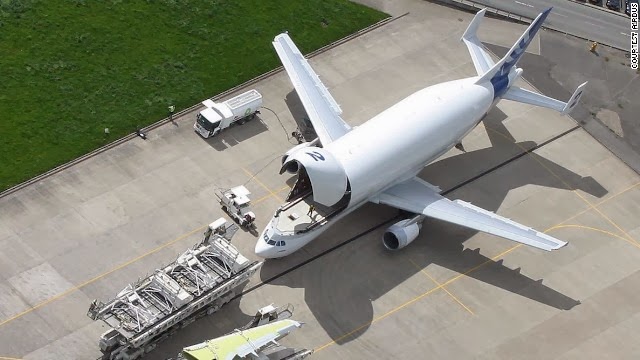
If there's ANYTHING known about Airbus, they make BIG flying machines.... Yes, take a good look at the Airbus Beluga, with the exception of the A380, this aircraft carries large sections of the Airbus family of aircraft into Toulouse, France for final assembly. 

STORY HIGHLIGHTS
  • Airbus' five Belugas are made to transport huge items, such as aircraft wings
  • The Beluga was designed to end Airbus' reliance on the Boeing Super Guppy
  • Airbus may be looking at a potential "Beluga XL" replacement
(CNN) -- If you ever find yourself in the French city of Toulouse, you might just see one of the oddest-looking aircraft in the world. Popularly known as the "Beluga," because of its strong resemblance to the white Arctic whale, the Airbus A300-600ST (ST stands for Super Transporter) is unique not only in appearance, but also for the essential role it performs in European aviation.

Airbus' production centers are scattered all over the continent, a legacy of its origins as a pan-European consortium.Each factory specializes in the completion of a specific section of an aircraft.

The five Belugas, all operated by Airbus, link these plants and take the different aircraft sections to the final assembly line, either in Toulouse or Hamburg.

The Beluga A300-600ST on Takeoff - Beluga #2 of the 5 in number 
The Beluga isn't serially produced, making each an "artisan" product. The A300-600ST Super Transporter can carry a payload of 47 metric tons (103,616 pounds) over a range of 1,500 nautical miles.

Frankenstein of cargo planes
Designing the Beluga wasn't easy. The top section of an Airbus A300-600 was cut off. A wider fuselage section was added, giving the plane its characteristic hump. The cockpit was lowered, allowing cargo to be loaded through the front of the aircraft.

A plane spotter's dream --- Wow. Beluga #3 

The legendary Beluga has brought many a plane spotter to Toulouse. Visitors can often be found sitting on the grass near Toulouse Blagnac Airport waiting for one of the five big beauties to take off or land.
Built for volume, not weight
With a diameter of 7.1 meters, the Beluga has an incredibly large cargo hold. Though its maximum payload of 47 tons is surpassed by only a handful of cargo aircraft, the hold makes it good for oversized but not particularly heavy cargo
Cockpit
The A300-600ST Super Transporter is operated by a crew of three: two pilots and a loadmaster.

Flying white whale - Spot the difference?
                                               
\


A300-600ST Super Transporter
The Beluga's jet speed and efficiency allows "for short transport times to meet strict production schedules," says Airbus. "A semi-automated main deck cargo loading system ensures easy and efficient handling of aircraft components." 


Sum of many parts


Aerial view


A Beluga can carry the wings of an A340 airliner or fuselage for Airbus' wide-body A350. It's not large enough to transport parts for the A380 super jumbo. Those travel by boat, barge and road. 


The Beluga's future
Airbus is looking at a potential replacement for the aging A300-600ST Super Transporter. Though no final decisions have been made, the "Beluga XL" is expected to have a longer range and ability to carry heavier payloads. 


Source


January 19, 2014

Bombardier Delays CSeries Launch


Bombardier is delaying the entry into service of its CSeries aircraft until the second half of 2015, after discovering that the flight test phase will require more time than originally anticipated. 

The delay will eliminate the Canadian airframe manufacturer's original plans for a CS100 introduction in September, about a year after its maiden flight occurred Sept. 16, 2013. Under the new launch schedule, the CS100 will be introduced in late 2015, followed by the CS300 entry into service about six months later. 

Photo, courtesy of Bombardier 


“While the process has taken more time than we had expected, our suppliers are aligned with the program’s schedule and together we will continue to work closely to move the program steadily forward. With the first flight of Flight Test Vehicle 2 (FTV2) successfully completed on Jan. 3, 2014, the CSeries aircraft program will continue to gain traction over the coming months," said Mike Arcamone, president of Bombardier.

Bombardier is looking to use the CSeries family to compete in the 100- to 149-seat market, which is currently dominated by the Boeing 737 and Airbus A320. The company's projected improvements in operating costs have influenced both Boeing and Airbus to introduce improved versions of those aircraft, including the A320neo and the 737 MAX. 


Take a look at how the A380 became REALITY


Go inside the world's largest commercial airliner, the A380


Link

Boeing Joins New BIOjet Abu Dhabi Team to Grow Biofuel Supply Chain in United Arab Emirates

- Collaboration focuses on research, feedstock production and refining capability

- Announcement follows Etihad 777 biofuel demonstration flight in Abu Dhabi

ABU DHABI, United Arab Emirates, Jan. 19, 2014 /PRNewswire/ -- Boeing [NYSE:BA], Etihad Airways, Takreer, Total and the Masdar Institute of Science and Technology today announced they will collaborate on a new initiative to support a sustainable aviation biofuel industry in the United Arab Emirates.
BIOjet Abu Dhabi: Flight Path to Sustainability will engage a broad range of stakeholders to develop a comprehensive framework for a U.A.E. biofuel supply chain. This initiative will focus on research and development and investments in feedstock production and refining capability in the U.A.E. and globally.

Boeing Joins New BIOjet Abu Dhabi Team to Grow Biofuel Supply Chain in United Arab Emirates.


Boeing, Etihad Airways, Takreer, Total and Masdar Institute of Science and Technology today announced they will collaborate on a new initiative, BIOjet Abu Dhabi: Flight Path to Sustainability, to support a sustainable aviation biofuel industry in the United Arab Emirates. Pictured here, Etihad Airways conducted a 45-minute demonstration flight on Jan. 18 with a Boeing 777-300ER (Extended Range), powered in part by the first sustainable aviation biofuel produced in the U.A.E.
Etihad Airways showed the promise of this homegrown effort yesterday with a 45-minute demonstration flight in a Boeing 777 powered in part by U.A.E.-produced sustainable aviation biofuel. The biofuel was partially converted from plants by Total and refined into jet fuel by Takreer, a wholly-owned subsidiary of Abu Dhabi National Oil Co. (ADNOC). U.A.E. is now among a handful of countries that have produced and flown on their own aviation biofuel, which emits at least 50 percent less carbon dioxide than fossil fuel over its lifecycle.
"In collaboration with our key partners, our goal is to support and help drive the commercialization of sustainable aviation fuel in Abu Dhabi, the region and also globally," said Etihad Airways President and CEO James Hogan. "We have made some important first steps in this process and our continued focus will be to develop further initiatives such as this which will facilitate the availability of sustainable aviation biofuels for Etihad Airways in the coming years."
Boeing and Etihad Airways are also among the founding partners of the Sustainable Bioenergy Research Consortium, hosted by the Masdar Institute in Abu Dhabi. The consortium has been researching and developing salt-tolerant plants that would be raw material for the same refining processes used to produce renewable fuel for the Etihad Airways flight.
The flight and BIOjet Abu Dhabi announcement lead into Abu Dhabi Sustainability Week and the World Future Energy Summit. These activities and Masdar Institute's aviation biofuel research are aligned with the Abu Dhabi Economic Vision 2030, which seeks to develop sustainable energy sources to diversify the U.A.E. economy and increase workforce opportunities for Emiratis.


"With further commitment and investment, the U.A.E., a global leader in commercial aviation, is well-positioned to lead efforts to make our industry more sustainable," said Jeffrey Johnson, president, Boeing Middle East. "Boeing works with partners around the world to advance sustainable biofuel development and sees great opportunity for BIOjet Abu Dhabi to have a positive impact in the U.A.E. and globally."
"Takreer is proud to have been involved in refining this aviation biofuel at its Abu Dhabi research center," said Takreer CEO Jasem Ali Al Sayegh. "We support the concept of using biofuel as a sustainable aviation fuel for a cleaner future in line with ADNOC's sustainability policy. We see this strategy as complementary to our future plans in meeting the rapid growth in demand for jet fuel in the country and the region in view of the expansion of the operations of airlines here."
Etihad Airways is an airline industry leader in supporting the development of lower-carbon renewable fuels. A member of the Sustainable Aviation Fuel Users Group (SAFUG), the airline operated the Gulf region's first biofuel flight in January 2011 with a Boeing 777 delivery from Seattle to Abu Dhabi powered by a blend of petroleum-based and certified plant oil-based jet fuel.
Boeing collaborates with airlines, research institutions, governments and other stakeholders to develop sustainable biofuel supply chains around the world, including the United States, Middle East, China, Brazil, Europe and Australia.
For more information, visit http://www.boeing.com/boeing/aboutus/environment/

Source - Boeing Media